




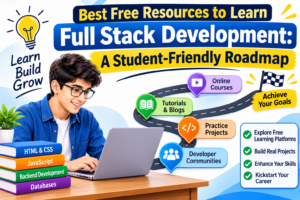

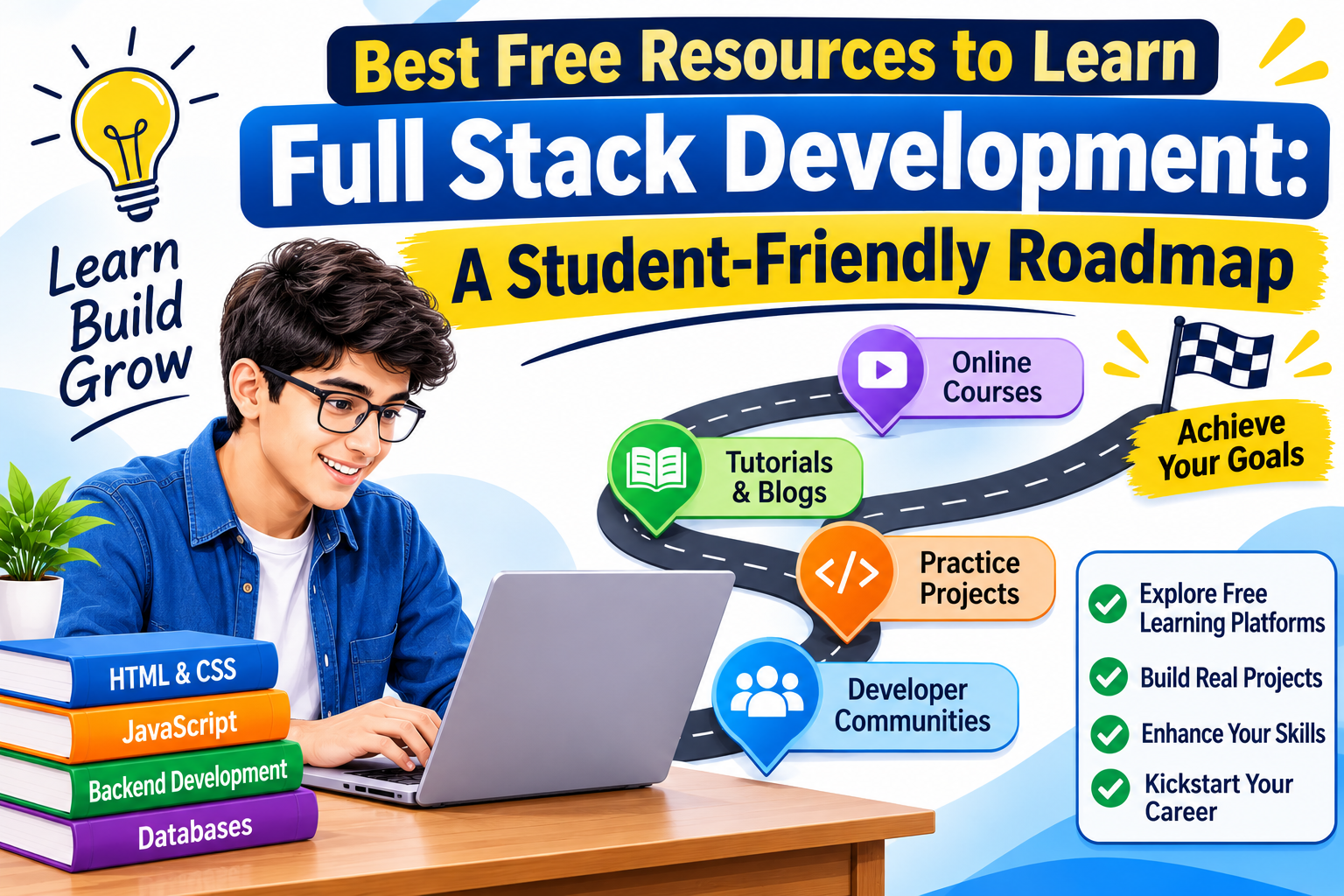
Best Free Resources to Learn Full Stack Development: A Student-Friendly Roadmap
The best free resources to learn full stack development include freeCodeCamp, The Odin Project, MDN Web Docs, Full Stack Open, Harvard CS50 Web, JavaScript.info, and official documentation from technologies such as React and Node.js.
If you are a complete beginner, start with HTML, CSS, and JavaScript. After building a strong frontend foundation, learn Git, GitHub, a frontend framework such as React, backend development with Node.js or another backend technology, databases, APIs, testing, and deployment.
The most important point is this: do not try to learn everything at once. Choose one structured resource, practice regularly, and build real projects while learning.
Best Free Resources to Learn Full Stack Development
Full stack development has become an attractive career option for students because it combines frontend development, backend development, databases, APIs, and deployment. However, starting can feel confusing because hundreds of courses, tutorials, YouTube videos, and documentation pages are available online.
The good news is that you do not need an expensive course to start learning full stack development.
Several high-quality resources are available completely free. Some provide structured courses, while others work better as reference material when you get stuck.
In this guide, you will discover the best free resources to learn full stack development, what each resource teaches, who should use it, and how to combine them into a practical learning roadmap.
What Is Full Stack Development?
Full stack development means working on both the frontend and backend of a web application.
The frontend is the part users see and interact with. It commonly involves:
- HTML
- CSS
- JavaScript
- React or another frontend framework
- Responsive design
- User interfaces
The backend handles the server-side functionality of an application. It can include:
- Server-side programming
- APIs
- Authentication
- Databases
- Business logic
- Security
- Deployment
A full stack developer understands how these different parts communicate with one another.
For example, when you log in to a website, the frontend collects your information, the backend processes the request, the database checks the information, and the server sends a response back to the frontend.
That is why learning full stack development requires more than simply learning a programming language.
1. freeCodeCamp – Best Overall Free Resource
freeCodeCamp is one of the strongest choices for students who want a structured way to learn web development without paying for a course.
Its learning model combines explanations, coding exercises, challenges, and projects. Current free learning options cover areas such as responsive web design, JavaScript, frontend development, relational databases, Python, and backend/API development.
What Can You Learn?
Depending on the current curriculum, students can explore:
- HTML
- CSS
- JavaScript
- Frontend libraries
- Python
- SQL
- Relational databases
- Backend development
- APIs
- Projects
Best for: Beginners who need structure and regular practice.
2. The Odin Project – Best for Learning by Building
If your goal is to become a practical developer rather than simply finish tutorials, The Odin Project deserves serious consideration.
The Odin Project offers a free full stack curriculum and focuses heavily on learning through projects. Its curriculum includes areas such as HTML, CSS, JavaScript, databases, React, Node.js, Ruby on Rails, and getting hired.
What Will You Practice?
Students can work with:
- HTML and CSS
- JavaScript
- Git and GitHub
- Command-line tools
- React JS
- Node Js
- Databases
- Backend development
- Real-world projects
The Odin Project describes its approach around three stages: learn, build, and connect. It also includes portfolio-oriented projects.
Best for: Students who learn best by creating projects.
3. MDN Web Docs – Best Technical Reference
MDN Web Docs should become one of your regular resources once you start serious web development.
MDN’s Learn Web Development section provides structured learning material for essential frontend skills and is designed to take learners from beginner level to a comfortable working level.
MDN covers important technologies including:
- HTML
- CSS
- JavaScript
- Web APIs
- Accessibility
- Responsive design
- Performance
- Browser technologies
Its curriculum also covers development tools and version control.
4. Full Stack Open – Best for Modern JavaScript
Full Stack Open, provided by the University of Helsinki, is an excellent free resource for students who already have some programming knowledge and want to move deeper into modern JavaScript development.
The course focuses heavily on React-based applications and backend services using Node.js. It also covers areas such as databases, testing, GraphQL, TypeScript, and continuous integration.
What Makes Full Stack Open Useful?
It connects different technologies instead of teaching them as isolated subjects.
You can learn how a frontend application communicates with backend services and how data is handled.
Topics include:
- React
- Redux
- Node.js
- REST APIs
- MongoDB
- GraphQL
- TypeScript
- Testing
- CI/CD
- Databases
The course is free, and the University of Helsinki states that students can obtain a certificate and ECTS credits without paying.
5. Harvard CS50 Web – Best for Strong Fundamentals
Harvard’s CS50 Web Programming with Python and JavaScript is another excellent free learning option.
The course goes beyond basic website creation and explores how web applications actually work.
The current course covers:
- HTML and CSS
- Git
- Python
- Django
- SQL
- JavaScript
- User interfaces
- Testing
- CI/CD
- Scalability
- Security
It also includes hands-on projects and a final project.
6. JavaScript.info – Best for Learning JavaScript Deeply
JavaScript is one of the most important technologies for modern full stack development.
However, knowing basic syntax is not enough.
You need to understand concepts such as:
- Variables
- Functions
- Objects
- Arrays
- DOM
- Events
- Promises
- Async/await
- Modules
- Classes
- APIs
JavaScript.info provides a detailed, text-based approach to JavaScript.
7. Official Documentation – Learn Directly From the Technology
Useful Documentation to Bookmark
Students learning full stack development should become comfortable with:
- MDN
- React documentation
- Node.js documentation
- Git documentation
- PostgreSQL documentation
- MongoDB documentation
- Express documentation
Do not worry if official documentation initially feels difficult.
Reading documentation is itself a skill that improves with practice.
8. YouTube – Best for Visual Learning
YouTube can also be a useful free resource for full stack development.
It is particularly helpful when you are struggling to understand a visual concept.
For example, you may understand CSS better after watching someone build a responsive website step by step.
However, there is one major problem.
YouTube can easily become a source of tutorial addiction.
You may watch 20 hours of tutorials without building a single project.
Therefore, use a simple rule:
Watch less. Code more.
For every tutorial you watch, try to build something yourself without copying the instructor line by line.
9. GitHub – Best for Projects and Portfolio Building
You can use GitHub to:
- Store projects
- Track changes
- Collaborate
- Practice Git
- Read other developers’ code
- Contribute to open-source projects
- Build a portfolio
Start uploading your projects early.
Your first project may not be impressive, and that is completely normal.
Over time, you can replace simple projects with better versions.
Best Free Full Stack Development Resources Compared
| Resource | Best For | Difficulty | Cost |
| freeCodeCamp | Structured learning | Beginner to Advanced | Free |
| The Odin Project | Project-based learning | Beginner to Advanced | Free |
| MDN Web Docs | Documentation & fundamentals | Beginner to Advanced | Free |
| Full Stack Open | Modern JavaScript stack | Intermediate | Free |
| CS50 Web | Strong concepts | Intermediate | Free |
| JavaScript.info | JavaScript | Beginner to Advanced | Free |
| Official Docs | Technology-specific learning | Intermediate to Advanced | Free |
| YouTube | Visual learning | Beginner to Advanced | Free |
| GitHub | Projects & collaboration | Beginner to Advanced | Free |
Best Free Full Stack Development Roadmap for Students
Step 1: Learn HTML
Start with:
- Semantic HTML
- Headings
- Paragraphs
- Links
- Images
- Forms
- Tables
- Accessibility basics
Build a simple personal website.
Step 2: Learn CSS
Next, learn:
- Selectors
- Box model
- Flexbox
- Grid
- Responsive design
- Positioning
- Media queries
- Basic animations
Build a responsive landing page.
MDN’s curriculum specifically includes HTML structure, CSS fundamentals, responsive development, accessibility, and other core frontend skills.
Step 3: Learn JavaScript
This is one of the most important stages.
Focus on:
- Variables
- Functions
- Arrays
- Objects
- Loops
- DOM manipulation
- Events
- Fetch API
- Promises
- Async/await
- Error handling
- Modules
Do not rush through JavaScript.
A strong JavaScript foundation makes React and backend JavaScript considerably easier.
Step 4: Learn Git and GitHub
Learn how to:
- Create repositories
- Commit changes
- Create branches
- Push code
- Pull code
- Resolve basic conflicts
- Write useful README files
Git is not optional if you want to work professionally.
Step 5: Learn React
Once JavaScript is comfortable, move to React.
Learn:
- Components
- Props
- State
- Events
- Hooks
- Forms
- Routing
- API integration
- State management basics
Then build a project rather than immediately jumping to another framework.
Step 6: Learn Backend Development
Now learn how servers work.
If you choose the JavaScript route, Node.js is a natural option.
Learn:
- Node.js
- Express
- REST APIs
- HTTP methods
- Authentication
- Authorization
- Error handling
- Environment variables
At this stage, your applications can start becoming much more realistic.
Step 7: Learn Databases
A full stack developer should understand how application data is stored.
Start with SQL and learn concepts such as:
- Tables
- Rows
- Columns
- Primary keys
- Foreign keys
- Relationships
- Queries
- Joins
- CRUD operations
After understanding relational databases, you can explore MongoDB or another NoSQL database.
Step 8: Build Real Projects
This is where learning becomes practical.
Start with small projects:
Beginner Projects
- Portfolio website
- Calculator
- To-do application
- Weather application
- Quiz application
Intermediate Projects
- Expense tracker
- Blog application
- Movie search application
- Authentication system
- E-commerce frontend
Advanced Projects
- Full-stack e-commerce application
- Learning management system
- Job portal
- Social networking application
- Project management system
Try to build projects that solve real problems.
How Long Does It Take to Learn Full Stack Development?
There is no fixed timeline because students learn at different speeds.
However, with consistent practice, a student can make meaningful progress in several months.
A simple schedule could look like this:
| Period | Main Focus |
| Month 1 | HTML + CSS |
| Month 2 | JavaScript |
| Month 3 | JavaScript + Git |
| Month 4 | React |
| Month 5 | Backend |
| Month 6 | Database + APIs |
| Month 7 | Full-stack projects |
| Month 8+ | Portfolio + interview preparation |
Do not treat this as a strict deadline.
If JavaScript takes longer, spend more time on JavaScript.
Strong fundamentals are more valuable than completing a roadmap quickly.
Common Mistakes Students Should Avoid
1. Watching Too Many Tutorials
Watching tutorials feels productive, but coding yourself is where real learning happens.
2. Learning Too Many Technologies
Do not learn React, Angular, Vue, Node.js, Python, Java, PHP, MongoDB, PostgreSQL, and ten other tools simultaneously.
Choose one stack first.
3. Copying Projects
4. Ignoring Git
5. Avoiding Documentation
6. Not Building a Portfolio
Final Verdict
The best free resources to learn full stack development are not necessarily the ones with the most videos. The best resource is the one that helps you understand concepts, practice consistently, solve problems, and build projects.
For most students, a combination works better than depending on one website.
A practical combination is: HTML + CSS → freeCodeCamp/MDN → JavaScript → The Odin Project → React → Node.js → Database → Full Stack Open → Real Projects → GitHub Portfolio
Remember that becoming a full stack developer is not about memorizing hundreds of programming commands.It is about learning how to think, build, debug, research, and solve problems.
Start small. Build one project. Then build another.If you stay consistent, the free resources available today can take you surprisingly far without requiring a large financial investment.