








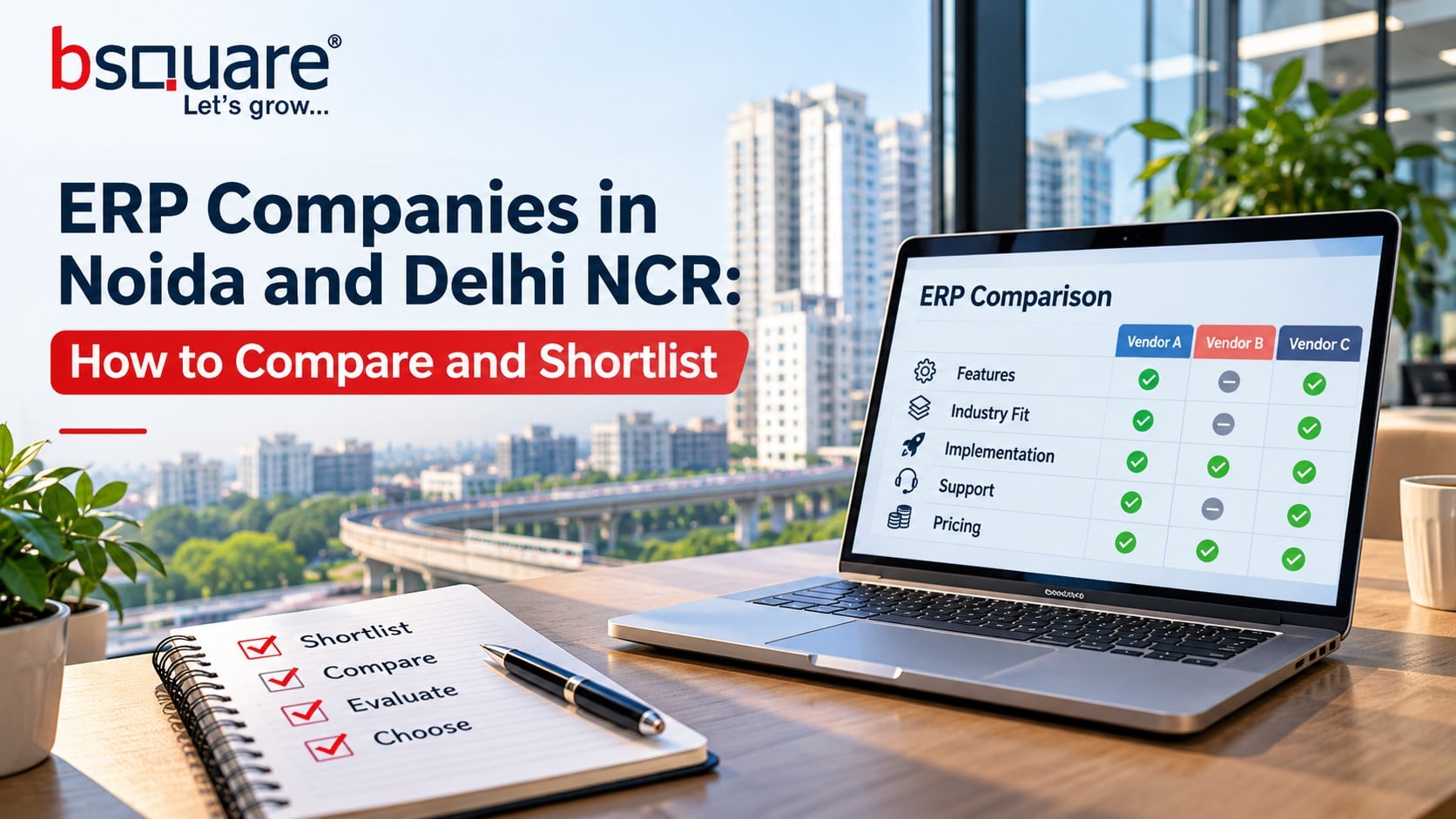
To compare ERP companies in Noida and Delhi NCR, shortlist four vendors, then score each on ten criteria: industry experience, product fit, implementation method, team, local support, verifiable references, cost transparency, post-go-live support, data migration and deployment options. Ask each one to demo your own data, call two of their clients, and compare the three-year total cost, not only the first quote.
Why does location matter when choosing an ERP company?
Location matters for support, not for software. A vendor in Noida, Greater Noida, Ghaziabad, Faridabad or Gurugram can visit your plant, sit with your stores and accounts teams, and reach you within hours when something breaks. That helps most during discovery, training, go-live and the first weeks after go-live.
It does not decide software quality. A distant vendor with a strong team can do the job, and a nearby one with a weak team cannot. Treat location as one criterion of ten, not the first filter.
What types of ERP companies work in Delhi NCR?
Most ERP companies in the region fall into five groups. Knowing the type helps you compare like with like.
| Type | What they sell | Often suits | Watch out for |
| Indian product vendor | Their own ERP, built for Indian rules (GST, e-invoicing) | Small and mid-size manufacturers | Check depth in your industry |
| Global ERP partner | Implementation of large global platforms such as SAP Business One or Microsoft Dynamics 365 | Larger or multi-country groups | Higher cost and longer projects |
| Open-source implementer | Odoo or ERPNext set-up and customisation | Teams with some in-house IT | Industry features may need custom work |
| Accounting add-on partner | Tally-based extensions and add-ons | Businesses that mainly need accounts | Limited production and costing depth |
| Industry specialist | ERP built or configured for one sector | Plants with unusual processes | Narrow fit if you diversify |
Bsquare Solutions, based in Noida, belongs to the first group: it builds and implements Pothera ERP for manufacturing and trading businesses.
How do you compare ERP companies? (10 criteria)
Score each vendor on these ten criteria.
- Industry experience. Have they worked with businesses like yours, with similar processes and size?
- Product fit. Does the standard software cover your must-haves without heavy customisation?
- Implementation method. Is there a documented, phase-by-phase process? See the 8 phases of an ERP implementation for what a sound plan looks like.
- Team. Who will actually work on your project, and how long have they been there?
- Local support. Can they be on site quickly, and what are their support hours?
- Verifiable references. Can you call two current clients in your industry?
- Cost transparency. Is the quote broken down into licence or subscription, implementation, customisation, training and support?
- Post-go-live support. What is included after go-live, and for how long?
- Data migration. Who cleans and loads your data, and how many trial loads are included?
- Deployment options. Do they offer cloud, on-premise or both?
How do you score the vendors?
Score each criterion from 0 to 2, then add them up. The maximum is 20 (10 criteria × 2 points).
- 0 = not available or not shown
- 1 = partly available, or only on request
- 2 = shown live or proven by a reference
| Total score | What it suggests |
| 16 to 20 | Strong fit. Move to references and pricing |
| 12 to 15 | Workable. Check the weak areas and their cost |
| Below 12 | Weak fit. Keep looking |
Give extra weight to criteria 2, 6 and 8 if you have no in-house IT team. These cause the most pain after signing.
How do you shortlist ERP companies? (6 steps)
- Write your must-haves. List ten processes your ERP must handle, such as stock by heat, costing or dealer credit.
- Build a long list of 8 to 10 companies. Use referrals from other manufacturers, industry associations, and search.
- Cut it to four. Remove vendors with no experience in your industry or no verifiable references.
- Request demos on your data. Send each vendor one real product, one stock sheet and one costing case.
- Call references. Speak to two clients per vendor, ideally in your industry and of your size.
- Compare three-year cost and pick two. Negotiate with both, then decide.
Why should you compare three-year cost, not the first quote?
Because a cheap first quote can hide costs that appear later. Compare licence or subscription, implementation, customisation, training, annual support and upgrades over three years.
Illustrative example (not actual quotes):
| Cost item | Vendor A (subscription) | Vendor B (licence) |
| Implementation | ₹8,00,000 | ₹5,00,000 |
| Subscription or licence over 3 years | ₹6,00,000 (₹2,00,000 a year) | ₹6,00,000 (one time) |
| Annual maintenance over 3 years | Included | ₹3,00,000 (₹1,00,000 a year) |
| Customisation | ₹1,50,000 | ₹3,50,000 |
| Three-year total | ₹15,50,000 | ₹17,50,000 |
(8,00,000 + 6,00,000 + 1,50,000 = 15,50,000; 5,00,000 + 6,00,000 + 3,00,000 + 3,50,000 = 17,50,000.) Vendor B has the lower implementation cost but the higher three-year total. The numbers are made up for explanation. Use the Bsquare ERP cost estimator for a starting range, then ask each vendor for a phase-wise quote.
What are the red flags when choosing an ERP company?
Watch for six warning signs:
- The vendor shows slides instead of your data in the demo
- They cannot name two clients in your industry who will take your call
- Most of your requirements are answered with “we can customise that”
- The quote lists one total with no breakdown
- The project plan has no testing or hypercare phase
- They promise a go-live date before understanding your data
What are 12 questions to ask every ERP company?
- Which industries and company sizes do you serve most?
- Which of my processes are standard, and which need customisation?
- Can you show my product or stock case live in a demo?
- Who will be on my project team, and what are their roles?
- What does your implementation plan look like, phase by phase?
- How long will first go-live take for my number of plants and users? (Pothera’s guide suggests 4 to 5 months for a single plant and longer for several, so ask for a vendor-specific plan.)
- Who cleans and migrates my data, and how many trial loads are included?
- How do you support us at go-live and in the first month?
- What does annual support cost, and what does it cover?
- How do you handle customisation requests after go-live?
- Can I call two current clients like me?
- What happens to my data if I leave?
For software-specific questions in your industry, use the wire and cable ERP checklist or read ERP for steel pipe and tube manufacturers as examples of what to test.
When should you go live after you choose a partner?
Pick a start-of-month or start-of-quarter date, away from your busiest periods. Read when is the best time to go live with a new ERP, and share your calendar with the vendor early.
Where does Bsquare Solutions fit?
Bsquare Solutions is a Noida-based company that builds and implements Pothera ERP. According to Pothera’s implementation guide, it has been implementing ERP for manufacturing and trading businesses for 25 years and has 1,000+ clients across India, the Middle East and Africa. Its team works with client staff from process mapping through hypercare.
You can read the full ERP implementation roadmap guide, explore Pothera’s inventory management and production and planning management, or visit Bsquare Solutions. Score us on the same ten criteria as everyone else.
Frequently asked questions
- How do I choose an ERP company in Noida or Delhi NCR?
Build a long list of 8 to 10, cut to four using your must-haves and references, request demos on your data, call two clients per vendor, and compare three-year cost. - Does a local ERP company matter?
It helps with site visits, training and fast support, but it does not decide software quality. Treat location as one of ten criteria. - What types of ERP companies are there in Delhi NCR?
Indian product vendors, global ERP partners, open-source implementers, accounting add-on partners and industry specialists. - How much does ERP cost for a manufacturer in India?
It depends on users, modules, plants and deployment. The ERP cost estimator gives a starting range. - How many ERP vendors should I shortlist?
Four is a practical number. Fewer limits your choice, and more makes demos and reference calls hard to manage. - How do I check an ERP company’s references?
Ask for two current clients in your industry and of similar size, and call them. Ask about delays, support after go-live and unexpected costs. - How long does ERP implementation take?
Pothera’s guide suggests 4 to 5 months to first go-live for a single plant, 6 to 7 months for 2 to 3 plants, and 8 to 10 months for multi-entity setups. Ask each vendor for a plan specific to you. - Should I choose cloud or on-premise ERP?
Cloud suits owners who want remote access to several sites. On-premise suits plants with weak internet. Ask whether the vendor offers both.
Talk to an ERP team in Noida
Share your process list and one stock or costing case, and we will show you how it would run. Book a free consultation with Bsquare and Pothera ERP, or get a budget range from the ERP cost estimator.