



A packaging operator at a formulation plant signs off on a revised line-clearance SOP every few months, and the record confirms that she completed the training. But whether she understands the changes well enough to explain them to a colleague or apply them correctly on the production line is a different question, especially when an error could affect batch quality or compliance.
Many pharmaceutical training systems focus on documenting completion, but an effective pharma LMS must go further. It should help employees understand procedures, verify their knowledge, maintain reliable training records, and keep learning aligned with changing SOPs and regulatory requirements.
What an LMS Has to Do in Pharma
A pharma LMS is a learning management system built for GxP-regulated work: it assigns SOP and mandatory training, delivers it, tests it and keeps the electronic records an inspector will ask to see. It has to run on a validated platform, with IQ/OQ/PQ documentation the quality team can show on request, because training records only count when the system holding them is validated.
Assignment comes next, and it works best by role. A QC analyst in Hyderabad and a granulation operator in the same company follow different SOPs, so they should never receive the same training list. A FRAC model (Function, Role, Activity, Competency) defines which procedures each job requires, and the LMS assigns training from that definition automatically. When someone changes roles, their training changes with them.
Short Lessons for Each Shift and Language
Plant teams work in shifts, and few operators can leave the floor for an hour of slides. Effective training breaks an SOP change into a lesson of five minutes or less, focused on what changed and why. A mobile lesson in Hindi or Telugu, available offline in the changing room before a shift, reaches more people than a classroom session scheduled for the first Tuesday of the month. Microlearning also makes refreshers practical, so a rarely used procedure can be reviewed the day before it is needed.
The same applies to people outside the payroll. Contract workers, temporary staff during a capacity ramp-up and third-party technicians who service equipment all touch GxP processes, and an inspector will expect their training records too. An effective platform trains them on the same SOP revisions, in the same short format, and keeps their records alongside everyone else’s.
Assessments That Check Understanding
A signature on a read-and-understood form proves the SOP was opened. It does not prove it was understood. Effective pharma training tests understanding with questions built from real situations on the floor:
- Scenario questions: what an operator should do when a balance fails its daily check in the middle of a batch.
- Practice conversations: AI role play lets a supervisor rehearse real-world situations, such as answering an inspector’s questions about a deviation, before facing them for real.
- Proctored qualifications: AI proctoring keeps the exams that carry regulatory weight honest, even on a night shift.
Results show which SOPs people struggle with, and that tells the quality team where the procedure itself may need rewriting.
Records Ready for an Inspection
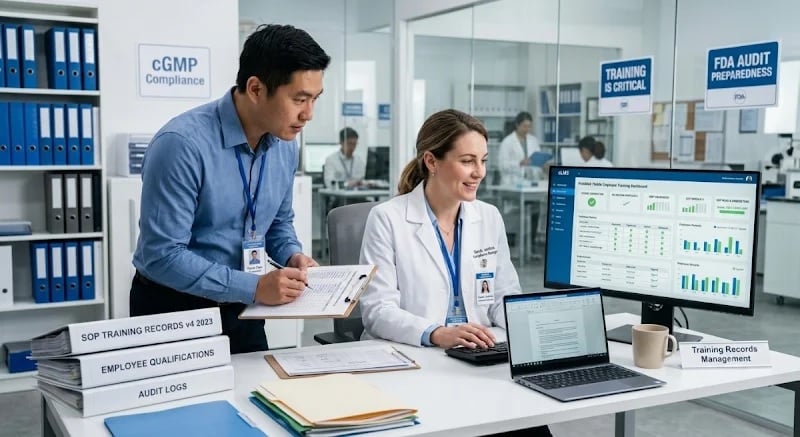
Every training event should leave a record that holds up without anyone assembling it: who was trained, on which SOP revision, when, with what score and with an electronic signature. An LMS for compliance should also escalate overdue certifications to a supervisor and then a department head before they lapse, rather than sending the operator one more reminder.
Enthral.ai brings this together in one AI-powered platform. Its validated pharma LMS completes IQ/OQ/PQ validation in 45 days and gives plants a paperless, GMP and FDA audit-ready training record, while the LXP layer delivers role-based microlearning, AI-driven assessments and roleplay-based coaching. Quality heads can see readiness by site and by role, alongside completion.
Connections to the Systems Pharma Already Runs
Training data is only useful when it moves. The LMS should pull roles and reporting lines from the HRMS, so assignments follow a promotion or a transfer without manual work. It should also link to the document management or quality system that holds SOP revisions, so a new revision triggers retraining on its own. Single sign-on (SSO) and RESTful APIs make both possible without asking IT to build custom connectors for each site. When a new hire joins the Goa plant, the HRMS record can create their training plan before their first shift, which means nobody starts work on a line they have not been qualified for.
Choosing a Pharma LMS That Trains People Well
Compliance and capability are often treated as separate goals in pharma training. In practice, they depend on each other. An operator who understands why a cleaning step changed follows it more consistently, and an inspector sees that consistency in the batch records long before opening the training file. When comparing options, quality and L&D teams can look past the course library and ask four practical questions.
Does the platform assign training by role? Can it teach an SOP change in five minutes, in the operator’s language? Does it test understanding as well as attendance? Will its records satisfy an inspector without a week of preparation? A system that answers all four builds a workforce that knows its procedures well enough to apply them on every shift.