






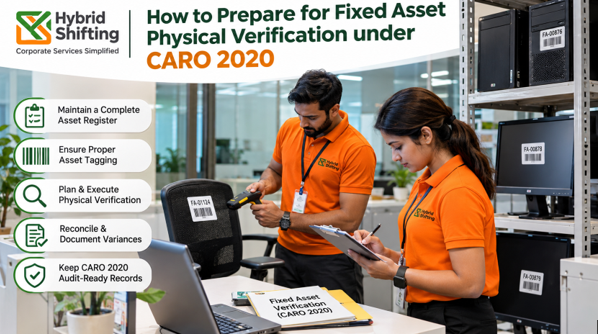
To prepare for fixed asset physical verification under CARO 2020, clean your fixed asset register, give every asset a unique ID, plan verification by location, count and photograph each asset against the register, reconcile differences and correct the books for material discrepancies. Keep signed evidence throughout. Your statutory auditor then reports on whether management verified assets at reasonable intervals.
Every year, finance teams scramble before the audit. Assets cannot be found, the register lists items that were sold years ago and nobody can say which floor a server is on. Verification done in a rush is slow, incomplete and hard to defend. Verification done as a routine takes days, not weeks.
This guide explains what CARO 2020 asks about fixed assets, what auditors look for and how to prepare, step by step.
What Does CARO 2020 Say About Fixed Assets?
The Companies (Auditor’s Report) Order, 2020 lists matters a statutory auditor must report on. For property, plant and equipment (PPE), clause 3(i) asks the auditor to state, in substance:
| Matter | What the auditor reports |
| Records | Whether the company maintains proper records showing full particulars of PPE, including quantitative details and situation (location) |
| Intangibles | Whether proper records of intangible assets are maintained |
| Physical verification | Whether management has physically verified PPE at reasonable intervals |
| Discrepancies | Whether any material discrepancies were noticed on verification and, if so, whether they were properly dealt with in the books of account |
The same clause also covers title deeds of immovable property, revaluation of assets, and proceedings relating to benami property. A separate clause deals with physical verification of inventory.
Two points matter for your preparation:
- The Order does not fix a frequency. It says “reasonable intervals”. Stating a period is not enough, since the auditor judges whether it is reasonable for your size and assets.
- The obligation to verify is management’s. The auditor reports on whether it was done and dealt with properly.
Does CARO 2020 Apply to Your Company?
It applies to most companies, with certain exemptions, such as for some small and private companies and some categories of entities. Thresholds and definitions can change, so ask your statutory auditor whether it applies to you and which clauses are relevant. If a company has no PPE, the verification clauses may not apply at all.
What Do Auditors Look For?
| What they check | Evidence that helps |
| Register completeness | Fixed asset register with full particulars, tag IDs and locations |
| Existence | Physical verification report with counts and photographs |
| Location | Site, floor and room recorded against each asset |
| Reasonable intervals | A written verification policy and cycle, with proof it was followed |
| Discrepancy handling | Exceptions list, investigation notes and correcting entries |
| Management review | Sign-offs by finance, IT and facilities heads |
How Do You Prepare? 10 Steps
1. Confirm scope and approach with your auditor
Agree which asset classes, locations and cut-off date will be covered, and what the auditor expects to see. Do this early, since it avoids rework.
2. Clean the fixed asset register first
Reconcile the register to the books. Retire disposed assets, fix duplicates and standardise categories. Tagging a dirty register just digitises old errors.
3. Define the minimum fields for each asset
Make sure every record carries the fields in the table below.
| Field | Why it matters |
| Unique asset ID | The key linking register and physical tag |
| Description, make, model, serial number | Identifies the item |
| Category and cost centre | Links to financial records |
| Location (site, floor, room) | Satisfies the “situation” requirement |
| Custodian | Who is accountable |
| Purchase date and cost | Financial context |
| Condition and status | In use, idle, damaged, in storage |
| Last verified date | Proof of verification cycle |
4. Tag every asset with a unique ID
Attach a barcode, QR or RFID tag, and keep one ID that never changes. See our guide to QR code, barcode or RFID asset tagging for choosing the right method by asset type.
5. Write the verification policy and plan
Document how often you will verify, who does it and how. Split work by location, and assign teams and dates. Include assets that are hard to reach, such as items in racks, storage or at remote sites.
6. Verify physically
For each asset, scan or count it, confirm the location, photograph it and note condition. Capture who verified it and when.
7. Reconcile findings against the register
Compare what you found with what the books say. Sort every difference into one of these groups:
| Result | What it means | Typical action |
|---|---|---|
| Matched | Found where and as recorded | Mark verified |
| Found, not recorded | Physically present but not in the register | Investigate source, add to register |
| Recorded, not found | In the register but not located | Search, then investigate and escalate |
| Wrong location or custodian | Found elsewhere | Update the register |
| Damaged or obsolete | Exists but unfit | Assess for repair, impairment or disposal |
| Duplicate or mis-described | Record error | Correct or merge |
8. Investigate and resolve discrepancies
Assign each exception an owner and a deadline. Record the finding, the reason and the resolution. See our upcoming guide on ghost assets for assets that exist only on paper.
9. Correct the books and register
Make adjusting entries under your approval policy for material discrepancies, with supporting documents. The auditor looks for proof that differences were “properly dealt with in the books”.
10. Document and sign off
Compile the verification report: scope, method, dates, counts, exceptions, resolutions and sign-offs. Keep it ready for the auditor, and set the next cycle date.
Which Assets Are Hard to Verify?
| Situation | How to handle it |
|---|---|
| Laptops with remote or work-from-home employees | Collect confirmation with a photo and tag scan, or retrieve the devices, and record the custodian. |
| Assets at multiple sites or cities | Plan verification by site, with a local coordinator and common templates. |
| Assets in storage or in transit | Verify at the storage location, and reconcile in-transit items at delivery. |
| Assets in server racks or data centres | Use rack-level inventory and tags suited to metal surfaces. |
| Assets at third-party locations | Obtain written confirmation, and record the basis. |
| Disposed or sold assets still on the register | Reconcile disposal documents and remove them. |
| Assets being moved during the year |
Scan at dispatch and arrival, and reconcile before the year-end. See asset tagging during a move. |
How Often Should You Verify?
CARO 2020 asks about “reasonable intervals” and sets no fixed number of years. Companies commonly verify all assets annually or cover locations and asset classes in a planned cycle, with higher-risk assets checked more often. Agree the cycle with your auditor, write it into your policy and follow it. A cycle that exists on paper but is not followed does not help you.
How Does Technology Help?
- Tagging gives each asset an ID the auditor can trace.
- Scanning records what was found, where, when and by whom, giving an evidence trail.
- Photographs and condition notes support existence and condition.
- Reconciliation reports show matched, missing and extra assets in one place.
- ERP integration keeps the register and the floor in step. Read how ERP integration works with physical asset data.
What Mistakes Should You Avoid?
- Starting verification weeks before the audit
- Tagging before cleaning the register
- No written policy or cycle
- Verifying only what is easy to reach
- Recording exceptions without owners or resolution
- Not updating the books after finding differences
- Losing the evidence, such as photos, sign-offs and scan logs
- Ignoring assets with employees or at third parties
- Treating verification as a once-a-year scramble
Pre-Verification Checklist
- Applicability and approach confirmed with the auditor
- Register reconciled to the books
- Unique ID on every asset
- Required fields complete
- Written verification policy and cycle
- Teams, locations and dates assigned
- Scanning tools and templates ready
- Exception categories and owners agreed
- Process for adjusting the books approved
- Evidence storage in place
How Can Hybrid Shifting Help?
Hybrid Shifting is India’s Corporate Services Solutions company. Its asset management solutions cover several parts of this process:
- Asset tagging and reconciliation: RFID and barcode-based tagging for inventory visibility and audit accuracy
- Asset audit and verification: physical verification and reconciliation against enterprise records
- IT asset management: device location, custody and status from allocation to disposal
- ERP integration: physical asset data connected to financial and operational enterprise systems
- Asset sale and disposal: transparent, auditable tracking of assets leaving enterprise inventory
During moves, every item gets a unique barcode or RFID tag before packing begins, tags are scanned at packing, loading, delivery and unpacking, and reconciliation at destination produces an audit-ready MIS report. See commercial moving solutions and our guide to corporate relocation services. For assets you no longer need, read about asset buyback and reinstatement and asset buyback vs resale vs e-waste recycling.
Hybrid Shifting has tagged 1M+ assets, manages 100,000+ work-from-home assets annually and serves 100+ clients across 15,000+ PIN codes. See our infrastructure and clients.
Hybrid Shifting supports management’s verification and records. It does not replace your statutory auditor, who reports independently.
Need your assets verified and your register reconciled before audit? Talk to Hybrid Shifting for a verification plan. Request a consultation
FAQs
What does CARO 2020 require for fixed assets?
For companies in scope, the auditor reports on whether proper records of property, plant and equipment are kept, including quantitative details and location, and whether management verified assets at reasonable intervals and dealt with material discrepancies in the books.
Is physical verification of fixed assets mandatory under CARO 2020?
CARO 2020 is an auditor’s reporting order. It makes the auditor report on whether management physically verified PPE at reasonable intervals. Confirm your obligations and approach with your statutory auditor.
How often should fixed assets be physically verified?
The Order does not fix a frequency. It uses “reasonable intervals”, which the auditor judges based on your size and assets. Many companies verify annually or in a planned cycle.
What happens if assets are missing at verification?
Investigate, record the findings and resolve them. Where discrepancies are material, they should be dealt with properly in the books, with supporting documents and approvals.
What documents should I keep?
Keep the verification policy, plan, scan logs, photographs, reconciliation report, exceptions list with resolutions, correcting entries and signed sign-offs.
How do I verify laptops held by remote employees?
Collect a tag scan or photo confirmation from each employee and update the custodian and location, or retrieve devices where needed, and keep the confirmations as evidence.
Does asset tagging replace physical verification?
No. Tagging makes verification faster and gives an evidence trail, but management must still verify and reconcile assets.
When should I start preparing?
Well before year-end. Clean the register and tag assets first, then verify and resolve exceptions with time left to correct the books.