





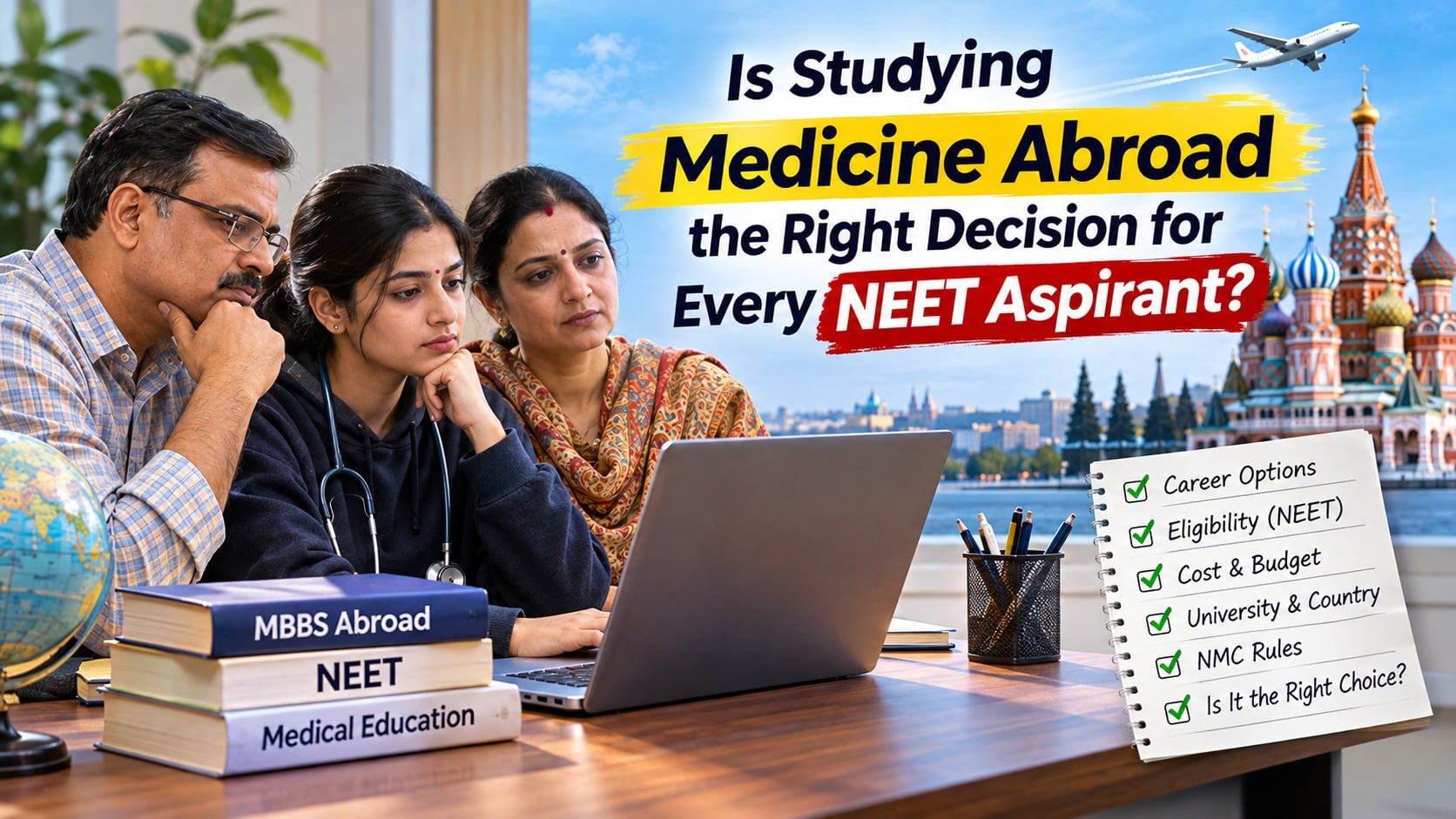
Is Studying Medicine Abroad the Right Decision for Every NEET Aspirant?
Every year, lakhs of students in India prepare for the NEET examination with one dream: becoming a doctor. For many, this dream begins during school and involves years of preparation, coaching classes, mock tests and sacrifices.
But what happens when a student qualifies NEET exam but does not secure an MBBS seat in an Indian government or private medical college?
This is where studying medicine abroad enters the conversation.
Countries such as Russia, Kazakhstan, Georgia, Kyrgyzstan and other international destinations attract Indian students who want to pursue medical education outside India. These options can provide another pathway for students who are unable to secure a suitable medical seat domestically.
However, there is an important question that every student and parent should consider: Is studying medicine abroad the right decision for every NEET aspirant?
The honest answer is no.
Studying MBBS abroad can be a good opportunity for some students, but it requires academic commitment, financial planning, emotional readiness and a clear understanding of the challenges involved.
Let’s understand what students should consider before making this decision.
Qualifying NEET Does Not Automatically Mean Studying Abroad Is the Best Option
Many students and parents start exploring foreign medical universities immediately after receiving their NEET results.
While this is understandable, students should not make a decision based only on their NEET score or the availability of seats.
A student should first evaluate their available options in India, including government and private medical colleges, their eligibility, admission prospects and financial requirements.
Studying abroad should be considered after understanding the complete picture rather than treating it as an immediate alternative to Indian medical colleges.
The objective should not simply be to secure an MBBS admission. It should be to choose an educational pathway that supports the student’s long-term medical career.
Students Must Have a Genuine Interest in Medicine
This is one of the most important factors.
Studying medicine requires years of consistent academic effort. Students have to understand complex subjects, attend practical sessions, participate in clinical training and develop the ability to handle medical responsibilities.
Living abroad can make this journey even more demanding.
Students who choose MBBS abroad only because their parents want them to become doctors may struggle to maintain motivation.
Before applying, students should ask themselves:
- Am I genuinely interested in studying medicine?
- Am I comfortable studying for several years?
- Can I manage academic pressure independently?
- Am I willing to adapt to a different country and culture?
- Do I understand the responsibilities of becoming a doctor?
If the motivation is genuine, studying abroad may be worth considering. If the decision is being made under family or social pressure, taking time to reconsider is important.
Understand the Financial Commitment Before Applying
One common reason Indian students consider medical education abroad is the possibility of finding comparatively affordable options.
However, affordability should never be judged by tuition fees alone.
The total cost of studying MBBS abroad may include:
- University tuition fees.
- Hostel and accommodation charges.
- Food and daily expenses.
- Visa and documentation costs.
- Medical insurance.
- International travel.
- Local transportation.
- Books and academic materials.
- Emergency and miscellaneous expenses.
The total expenditure varies significantly depending on the country, university, city and lifestyle.
Parents should prepare a complete financial plan for the entire duration of the programme. They should also consider currency fluctuations and possible increases in living expenses.
Taking an education loan or using family savings without understanding the complete financial commitment can create unnecessary pressure later.
Studying in a Foreign Country Requires Emotional Readiness
Moving from India to another country is not just an educational decision. It is also a major lifestyle change.
Students may experience homesickness, cultural differences, unfamiliar food, language barriers and difficulty adjusting to a new environment.
For students who have never lived away from their families, the initial months can be particularly challenging.
Before choosing MBBS abroad, students should consider whether they are comfortable with:
- Living independently.
- Managing their daily routine.
- Preparing for examinations without constant parental supervision.
- Communicating with people from different backgrounds.
- Adjusting to unfamiliar weather and food.
- Seeking help when facing difficulties.
A student who is emotionally prepared to live independently will generally find it easier to adjust to international student life.
Language Barriers Can Affect Medical Education
Many international medical universities offer programmes in English. This makes them accessible to students from India and other countries.
However, students should understand the difference between classroom teaching and practical clinical training.
In some countries, patients primarily communicate in the local language. Medical students may therefore need to learn that language to communicate effectively during hospital rotations and clinical practice.
For example, students pursuing MBBS in Russia may receive academic instruction in English, but learning Russian remains important for everyday communication and interaction with patients.
Before admission, students should verify the actual language of instruction throughout the programme and understand the local language requirements for clinical training.
University Selection Matters More Than the Country’s Popularity
Choosing a country is only the first step. Selecting the right medical university is equally important.
Not every university offers the same academic environment, clinical exposure, teaching facilities or student support.
Students should carefully evaluate:
University eligibility: Verify that the institution and programme meet the applicable National Medical Commission requirements for Indian students.
Course structure: Understand the programme duration, curriculum, academic calendar and examination system.
Clinical exposure: Check the availability of teaching hospitals and practical training opportunities.
Medium of instruction: Confirm whether the entire programme is taught in English as required under applicable Indian regulations.
Accommodation: Understand hostel facilities, food availability, security and distance from the university.
Student support: Check whether international students receive assistance with documentation, accommodation and academic concerns.
A university should be selected based on its academic suitability and regulatory compliance, not simply because it offers an attractive admission package.
Understand the NMC Rules Before Taking Admission
This is a point that every NEET aspirant and parent must take seriously.
Indian students planning to pursue medical education abroad should understand the Foreign Medical Graduate Licentiate Regulations, 2021, and other applicable National Medical Commission requirements.
These regulations establish important conditions for foreign medical graduates seeking registration in India.
Students should pay particular attention to:
- The prescribed duration of the medical course.
- The medium of instruction.
- Required subjects and clinical training.
- Internship requirements.
- Eligibility for registration in the country where the qualification is awarded.
- Applicable licensing and screening examination requirements in India.
The Foreign Medical Graduate Examination (FMGE) has historically been used as a screening examination for eligible foreign medical graduates. Students should also follow official updates concerning the National Exit Test (NExT) and any applicable transitional arrangements.
Most importantly, qualifying NEET does not guarantee eligibility for medical registration in India after graduation. The foreign medical qualification and the student’s complete course and internship pathway must satisfy the applicable regulations.
Students should verify the latest official NMC notifications before making an admission decision.
Studying Abroad Does Not Mean the Academic Journey Becomes Easier
Some students believe that studying medicine abroad is an easier way to become a doctor.
This is a misconception.
Medical education is demanding regardless of the country. Students must study subjects such as anatomy, physiology, biochemistry, pathology, pharmacology and medicine.
They also need to develop practical knowledge and clinical skills.
International students must additionally adjust to different teaching methods, examination patterns and academic expectations.
A student who is not willing to study consistently may struggle abroad just as they might in India.
The decision should be based on the quality of education and the student’s willingness to work hard, not on the assumption that foreign medical education offers an easy route to becoming a doctor.
Consider Your Long-Term Career Goals
Before selecting an international medical university, students should think about where they want to practise after graduation.
Do they want to return to India? Are they interested in pursuing postgraduate medical education? Would they consider working in another country if they meet its licensing requirements?
These questions matter because medical licensing systems differ between countries.
A student planning to return to India must understand the applicable NMC requirements and licensing pathway.
Similarly, anyone considering practising in another country should research that country’s registration, language and licensing requirements.
Having a clear career direction before admission can help students avoid confusion and unexpected difficulties after completing their degree.
Do Not Make an Admission Decision Under Pressure
NEET results can be emotionally challenging, particularly for students who have spent years preparing for the examination.
Some students may feel that they have disappointed their families or lost an important opportunity.
This is precisely when making a rushed admission decision can become a problem.
Students should take enough time to compare universities, understand the fee structure, check official documentation and discuss their options with their parents.
Be cautious of admission promises that sound too good to be true, especially guaranteed licensing outcomes, unrealistic fee commitments or claims that regulatory requirements do not matter.
Every payment should be supported by official documentation and a clear written fee structure.
Who Should Consider Studying MBBS Abroad?
Studying medicine abroad may be a suitable option for students who:
- Have qualified NEET and meet the applicable eligibility requirements.
- Have a genuine interest in pursuing medicine.
- Are unable to secure a suitable medical seat in India.
- Have a realistic financial plan for the complete programme.
- Are comfortable adapting to a different culture and lifestyle.
- Are prepared to study independently and consistently.
- Understand the regulatory requirements for practising medicine in India.
On the other hand, students who are unsure about pursuing medicine, are financially unprepared or are unwilling to adapt to an international environment should take more time before making a decision.
There is no universal answer. The right choice depends on the individual student.
Final Thoughts
Studying medicine abroad can open doors for Indian students who want to pursue their dream of becoming doctors. It provides an alternative educational pathway, but it also comes with responsibilities that should not be ignored.
A foreign medical degree is not a shortcut to becoming a doctor. It requires academic dedication, financial preparation, cultural adjustment and careful attention to licensing requirements.
For NEET aspirants and their parents, the best approach is to compare all available options before making a commitment.
At EOCL India, students and parents can seek guidance on international medical education, university selection, admission procedures and the important considerations involved in studying MBBS abroad.
Remember, the goal is not just to get admission into a medical university. The goal is to build a successful future in medicine.
Choose your medical education pathway with the right information, realistic expectations and a clear understanding of your future goals.