






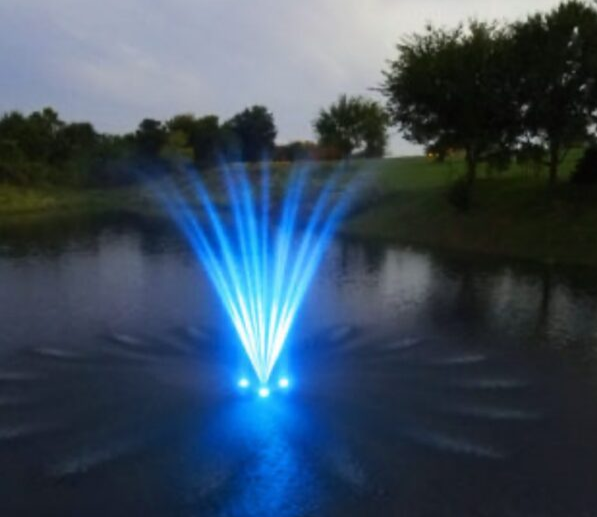
A pond that looks calm by day can turn dull after sunset without some form of illumination. Lighting brings back the shape of the spray, the movement of the water, and the edges of the pond itself. Choosing water fountain lights takes more than picking a color, because voltage, wattage, and mounting all affect safety and results.
How Pond Fountain Lighting Works
Most pond systems use low-voltage LED fixtures that run on 12 volts through a transformer. LEDs draw little power and produce minimal heat, so they can run for hours without adding much to an electric bill. Fixtures are sealed against moisture, and permanently submerged units should carry an IP68 rating, which covers continuous immersion.
A typical small kit includes three LED fixtures with a combined draw of about 6 watts and a long power cord, sometimes 100 feet. The fixtures mount near the spray pattern, so the water catches the light as it rises and falls. This layout suits small to medium ponds and decorative features.
Choosing the Right Light Color
Color changes both mood and visibility. White light gives the highest contrast and shows the spray pattern clearly at night. Color-changing kits work better for decoration, since they cycle through shades that add a festive look.
Pond owners with fish should think carefully. Warm white in the 2700K to 3000K range is often recommended for koi ponds because it keeps natural fish coloring intact, while cool white can wash out reds and oranges. Whatever the choice, water fountain lights that stay on a timer help reduce disturbance to fish and wildlife at night.
Matching Lights to Fountain Size
Fixture strength should scale with the feature. Tall sprays need more lumens and wider beams to illuminate the full column of water, while short sprays do better with focused fixtures that avoid glare. Typical LED units in the 3 to 12 watt range produce roughly 240 to 1,200 lumens, which is enough for many small residential ponds.
Water clarity and depth matter as well. Murky water absorbs light, and dark liners reflect less of it. If the pond is cloudy, a brighter fixture or closer placement may be needed. Consider these questions before buying:
- How tall is the spray?
- How deep is the water near the fountain?
- What color is the liner?
- Does the existing fountain have mounting points?
- Is a power outlet within reach?
Electrical Planning and Safety
Low voltage does not mean zero planning. Add up the wattage of all fixtures, then choose a transformer with spare capacity. One common rule is to load a transformer to only about 90 percent of its rating, so a 60-watt unit would run no more than 54 watts. Another guideline suggests selecting a transformer rated about 20 percent above total load.
Cable length affects brightness. Over long runs, voltage drops, and lights at the far end appear dimmer. For distances beyond 50 feet, heavier 12-gauge cable is advised, and technicians often check voltage at the fixture with a multimeter. Readings below 10 volts on a 12-volt system suggest a problem.
Always connect the transformer to a receptacle protected by a ground fault circuit interrupter. Disconnect power before handling or servicing any fixture, and never enter the water while equipment is plugged in. Electrical work near water should be handled by a qualified technician and follow local code.
Installation and Upkeep
Installation is straightforward when the plan is clear. Set the fixtures in position near the nozzle, run the cable back to the transformer, and keep connections waterproof. Standard wire nuts do not belong underwater. Test the system before the fountain is running, and place the transformer on a timer.
Maintenance is light. Wipe algae and mineral film off the lenses every few weeks, since buildup reduces output. Check cables for cracks, and remove fixtures during hard freezes if the manufacturer advises it. LED units are often rated for tens of thousands of hours, so replacement is rare when the seals remain intact.
Conclusion
Good lighting rests on a few decisions: the right color, enough output, a properly sized transformer, and a safe electrical setup. Matching these to the pond keeps the display attractive and the water safe for fish and plants. Owners of floating pond fountains can mount compatible kits directly on the fountain base for even coverage of the spray. Careful planning today means the pond keeps glowing for seasons to come.