




Carbon Credit Market to Reach USD 8,216.86 Million by 2034, Driven by Rising Corporate Net-Zero Commitments and Global Decarbonization Initiatives
The global Carbon Credit Market is witnessing remarkable growth as governments, corporations, and financial institutions increasingly focus on reducing greenhouse gas emissions and achieving climate neutrality targets. Carbon credits have become an important financial instrument for supporting emission reduction, renewable energy development, forest conservation, and carbon removal projects. Growing environmental awareness, stricter government regulations, and increasing corporate sustainability commitments are encouraging organizations to participate in carbon trading and offset programs. Furthermore, advancements in blockchain technology, digital carbon registries, satellite monitoring, and carbon capture solutions are improving market transparency and creating new investment opportunities.
To know the most attractive segments, click here for a free sample of the report: https://www.maximizemarketresearch.com/market-report/carbon-credit-market/198127/
1. Carbon Credit Market Estimation, Growth Drivers and Opportunities
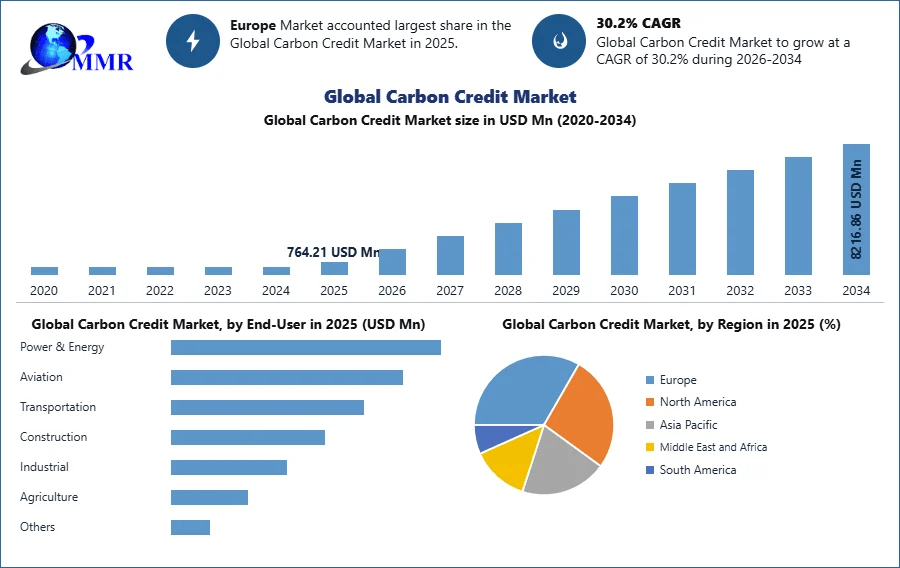
According to Maximize Market Research, the global carbon credit market was valued at USD 764.2 million in 2025 and is expected to reach nearly USD 8,216.86 million by 2034, growing at a CAGR of 30.2% during the forecast period of 2026–2034. The market is witnessing substantial expansion as businesses, governments, and financial institutions increasingly prioritize carbon emission reduction and climate sustainability initiatives.
The growing adoption of corporate net-zero emission commitments is a major factor contributing to market growth. Organizations across power generation, aviation, transportation, manufacturing, and construction are increasingly purchasing carbon credits to compensate for unavoidable greenhouse gas emissions and achieve their environmental sustainability objectives. Rising pressure from investors, consumers, and regulatory bodies is encouraging companies to integrate carbon offsetting and emission reduction strategies into their business operations. Consequently, carbon credits generated through renewable energy installations, afforestation, methane recovery, and energy efficiency projects are gaining popularity among corporate purchasers.
Increasing government support and the implementation of carbon pricing mechanisms are further strengthening market development. Emissions trading schemes, carbon taxation policies, and mandatory greenhouse gas reporting regulations are compelling industries to adopt more effective emission management practices. Moreover, international climate cooperation initiatives under the Paris Agreement are creating opportunities for cross-border carbon credit trading and encouraging investments in verified emission reduction projects. These regulatory developments are expected to improve market transparency and increase participation from both public and private sector organizations.
Technological innovation is also creating promising opportunities in the carbon credit market. The integration of blockchain technology, artificial intelligence, satellite-based monitoring, and digital measurement, reporting, and verification (MRV) systems is improving carbon credit tracking, transparency, and verification accuracy. These technologies help minimize fraudulent transactions and double counting while strengthening buyer confidence. Additionally, growing investments in direct air capture, biochar production, soil carbon sequestration, and carbon capture and storage (CCS) technologies are expanding the availability of carbon removal credits and supporting the development of innovative carbon reduction solutions.
Furthermore, increasing participation from financial institutions, investment funds, and institutional investors is creating new opportunities for market expansion. Carbon credits are gaining recognition as an important instrument for climate finance, enabling investors to support sustainable development and emission reduction initiatives. Companies focusing on high-quality carbon offset projects, reliable verification mechanisms, transparent trading platforms, and advanced carbon management technologies are expected to benefit from the growing demand for credible carbon credits worldwide.
2. United States Carbon Credit Market: Latest Trends and Investments in 2024
The United States carbon credit market witnessed notable growth and investment activity in 2024, driven by supportive government policies, rising corporate decarbonization commitments, and increasing funding for carbon removal technologies. On May 28, 2024, the U.S. Department of the Treasury, Department of Agriculture, and Department of Energy introduced new principles for responsible participation in voluntary carbon markets, highlighting the importance of transparency, credit credibility, and environmental integrity. In January 2024, Grassroots Carbon announced an agreement to provide Microsoft with soil carbon removal credits generated through regenerative ranching practices, reflecting growing corporate interest in nature-based carbon reduction solutions. Furthermore, in July 2024, 1PointFive, a subsidiary of Occidental, entered into an agreement to supply Microsoft with 500,000 metric tons of direct air capture carbon removal credits over six years. The credits are expected to be generated through the company’s STRATOS direct air capture facility in Texas. This agreement marked an important commercial development for large-scale engineered carbon removal technologies. Collectively, these initiatives highlight increasing investments in nature-based carbon sequestration, direct air capture infrastructure, and high-quality carbon credit procurement, strengthening the United States’ position in the global carbon credit market.
3. Carbon Credit Market Segmentation: Largest Market Share
By Type: The compliance segment held the largest market share in the global carbon credit market in 2025. Its dominance is primarily attributed to mandatory emission reduction requirements, government-operated emissions trading systems, and increasing carbon pricing regulations. Industries such as power generation, steel, cement, chemicals, and aviation are required to manage their emissions through applicable compliance mechanisms. The expansion of the European Union Emissions Trading System and China’s national carbon trading program further supports segment growth.
By Project Type: The avoidance/reduction projects segment accounted for the largest market share. These projects include renewable energy generation, energy efficiency improvements, methane capture, landfill gas recovery, and industrial emission reduction initiatives. Their dominance is supported by established project development models, relatively mature verification methodologies, and their ability to generate measurable greenhouse gas reductions.
By End User: The power and energy segment dominated the global carbon credit market in 2025. Electricity generation remains a major source of greenhouse gas emissions, encouraging utilities and power producers to invest in emission reduction initiatives and carbon credit procurement. Increasing renewable energy deployment, energy efficiency investments, and stricter emission requirements are further supporting demand from this segment.
4. Carbon Credit Market Competitive Analysis
The global carbon credit market includes carbon project developers, certification organizations, carbon trading platforms, and sustainability service providers. According to the companies listed in the Maximize Market Research report, five important participants are Shell, South Pole, Verra, Climate Impact Partners, and 3Degrees. Their investments in carbon removal, project verification, and digital carbon management are supporting the development of the industry.
1. Shell: Shell is an important participant in carbon credit procurement and carbon management services. The company invests in nature-based solutions, forest conservation, and carbon reduction projects. According to its 2024 annual reporting, Shell accounted for the retirement of 17.3 million carbon credits during 2024. Approximately 74% of these credits were certified under Verra’s Verified Carbon Standard, demonstrating its focus on recognized certification frameworks. Its continued involvement in carbon credit procurement and project screening supports market demand and encourages improvements in credit quality.
2. South Pole: South Pole is strengthening its position through carbon project development, climate consulting, and investment in emission reduction initiatives. In April 2024, the company secured a new investment round involving major shareholders, including GenZero, Corisol, and Lightrock, to accelerate its strategic transformation. Additionally, South Pole and GenZero launched the Asia Centre of Carbon Excellence in Singapore in April 2024, with support from the Singapore Economic Development Board. The initiative focuses on carbon project development, international carbon trading, and climate policy expertise, creating opportunities for high-quality carbon credit generation across Asia.
3. Verra: Verra is one of the leading carbon credit certification organizations, operating the Verified Carbon Standard program. In September 2024, Verra released an updated version of its Improved Agricultural Land Management methodology, VM0042 v2.1. The revision allows projects to distinguish between greenhouse gas emission reductions and carbon dioxide removals. The company also continued improving measurement and verification requirements for soil carbon projects. These developments strengthen transparency, improve credit classification, and support the expansion of regenerative agriculture-based carbon credit projects.
4. Climate Impact Partners: Climate Impact Partners is expanding its carbon removal portfolio through investments in nature-based and technology-driven solutions. In August 2024, the company launched a carbon dioxide removal program designed to support innovative technologies, including direct air capture, ocean alkalinity enhancement, and enhanced rock weathering. The initiative provides companies with opportunities to finance emerging carbon removal technologies and increase the availability of durable carbon credits. Its strategy supports diversification of carbon project portfolios and encourages investment in advanced climate solutions.
5. 3Degrees: 3Degrees is strengthening its market position through innovative carbon removal solutions and strategic project partnerships. In June 2024, the company launched its Carbon Removal Suite, featuring CDR Bridge and CDR Catalyst to help organizations access verified carbon removal credits. Additionally, in May 2024, 3Degrees partnered with CarbiCrete to develop carbon credit opportunities through low-carbon concrete manufacturing. CarbiCrete’s technology replaces traditional cement with steelmaking by-products and permanently stores carbon dioxide through mineralization. These initiatives support industrial decarbonization and create opportunities for technology-based carbon credit projects.
5. Carbon Credit Market Regional Analysis
United States: The United States represents an important carbon credit market, supported by corporate net-zero commitments, voluntary carbon trading initiatives, and investments in carbon capture technologies. The Inflation Reduction Act provides incentives for carbon capture and storage through Section 45Q tax credits, encouraging investment in direct air capture and industrial carbon removal projects. In 2024, federal agencies also introduced principles for responsible participation in voluntary carbon markets, strengthening transparency and buyer confidence.
United Kingdom: The UK carbon credit market benefits from its established Emissions Trading Scheme, climate commitments, and increasing corporate demand for verified emission reductions. In November 2024, the UK government announced plans to expand the UK ETS to include maritime emissions from 2026 and improve incentives for carbon capture and storage. These developments are expected to encourage industrial decarbonization and create additional demand for carbon management solutions.
Germany: Germany is an important European carbon market supported by its energy transition strategy, industrial decarbonization investments, and participation in the EU Emissions Trading System. Its national emissions trading system also covers heating and transport fuels not included in the EU ETS. Government initiatives promoting renewable energy, industrial efficiency, and low-carbon technologies are encouraging companies to reduce emissions and participate in carbon pricing mechanisms.
France: France offers significant opportunities through its national Low-Carbon Label, which supports verified projects that reduce greenhouse gas emissions or remove carbon dioxide from the atmosphere. The government encourages investment in forestry, agriculture, and environmental conservation projects through this certification framework. Furthermore, participation in the EU ETS and national climate objectives is supporting demand for credible carbon reduction and sequestration initiatives.
Japan: Japan is developing its carbon credit market through the Green Transformation strategy and its GX League emissions trading framework. The government introduced a voluntary emissions trading mechanism in 2023, with plans for a full-scale system from fiscal year 2026. Japan’s focus on carbon neutrality by 2050, energy efficiency, and industrial decarbonization is creating opportunities for carbon credit trading, renewable energy projects, and carbon capture technologies.
China: China represents an important market because of its large industrial base, substantial greenhouse gas emissions, and expanding national emissions trading system. In July 2024, the Ministry of Ecology and Environment announced plans to strengthen the national carbon market through expanded sector coverage and improvements in carbon allowance allocation. The government also emphasized support for ecosystem carbon sequestration, renewable energy, methane control, and energy efficiency projects, creating opportunities for domestic carbon credit development.
Regional Market Position: Europe held the largest regional share of the global carbon credit market in 2025. Its leadership is supported by the established EU Emissions Trading System, stringent environmental regulations, increasing carbon pricing mechanisms, and strong participation from industrial and power generation companies. North America also maintained a considerable market position, supported by corporate climate commitments and investments in carbon capture, direct air capture, and renewable energy projects.
6. Conclusion
The global carbon credit market is positioned for substantial growth as governments and businesses accelerate their transition toward low-carbon economies. Increasing regulatory requirements, corporate net-zero commitments, and investments in renewable energy and carbon removal technologies will remain important growth drivers. In my view, the greatest opportunity lies in developing high-integrity carbon credits supported by transparent measurement, reporting, and verification systems.
Companies should prioritize investments in direct air capture, biochar, regenerative agriculture, forest conservation, and carbon capture and storage technologies. Additionally, blockchain-based trading platforms and satellite monitoring systems can improve transparency, strengthen investor confidence, and reduce concerns regarding fraudulent or duplicated credits. The expansion of mandatory emissions trading systems across major economies will further increase market participation. Overall, organizations combining technological innovation, credible certification, and long-term carbon project investments are expected to benefit from the rapidly expanding global carbon credit industry.
To know the most attractive segments, click here for a free sample of the report: https://www.maximizemarketresearch.com/request-sample/198127/
About us
Maximize Market Research publishes sector forecasts, competitive analysis, and consulting insight for teams evaluating demand, competition, pricing, and growth strategy across high-value industries.
MAXIMIZE MARKET RESEARCH PVT. LTD.
2nd Floor, Navale IT Park Phase 3
Pune Banglore Highway, Narhe
Pune, Maharashtra 411041, India
+91 9607365656
sales@maximizemarketresearch.com