






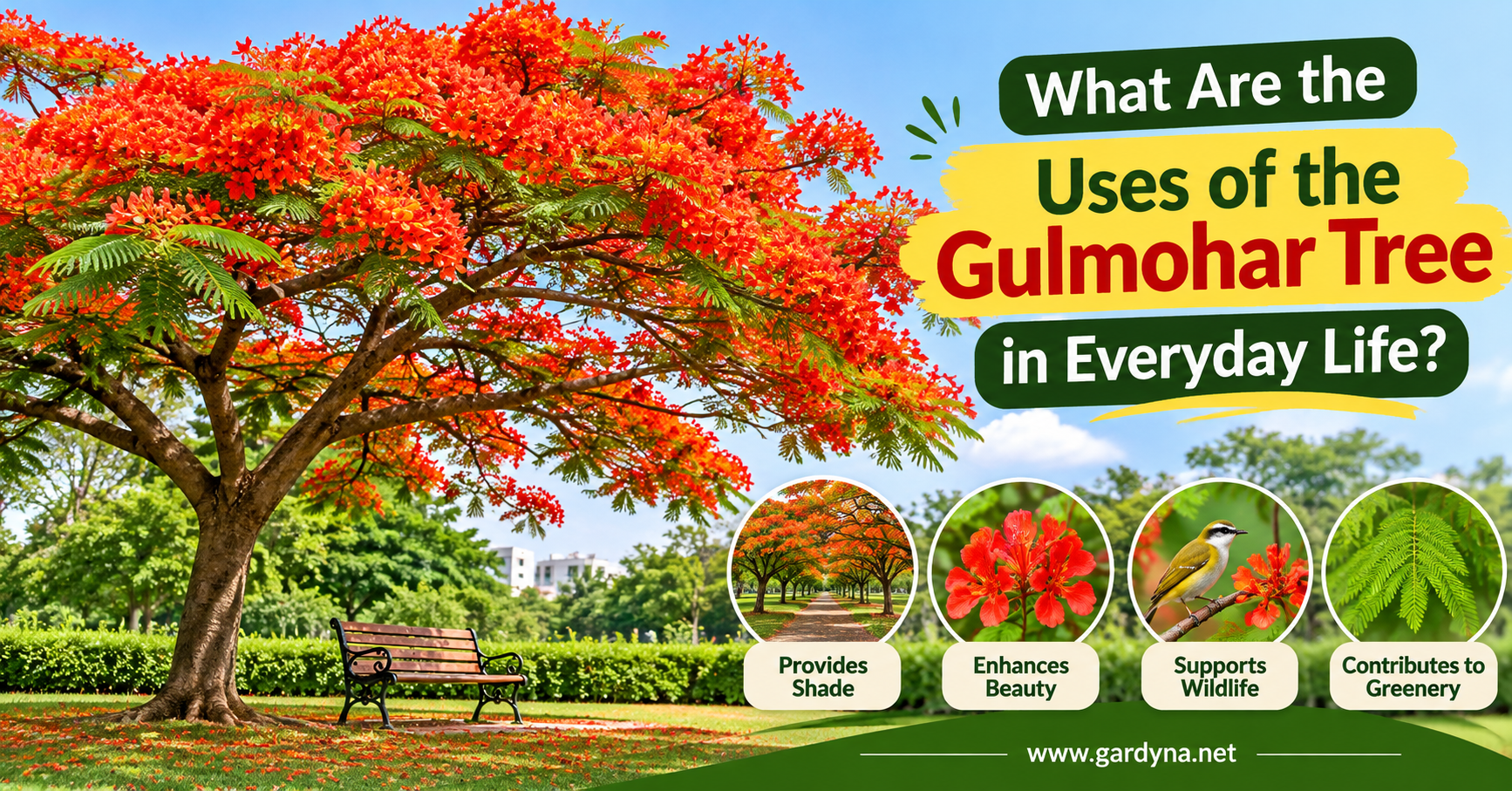
The Gulmohar tree is widely recognised for its vibrant red-orange flowers, spreading branches, and attractive appearance. Commonly known as the Flame Tree or Royal Poinciana, it is a popular ornamental tree found in parks, gardens, roadsides, and residential areas. However, its importance goes beyond its beauty. The Gulmohar tree offers several practical and environmental benefits, making it valuable in everyday life.
The Gulmohar tree scientific name is Delonix regia, and it belongs to the Fabaceae family. From providing shade to supporting urban greenery, there are several uses of the Gulmohar tree worth understanding.
1. Provides Shade in Public and Residential Spaces
One of the most common uses of the Gulmohar tree is providing natural shade. Its wide, umbrella-shaped canopy spreads across a large area, making it suitable for outdoor spaces.
Keeps Outdoor Areas Cooler
The dense foliage helps reduce direct sunlight reaching the ground. This makes the surrounding areas more comfortable during hot summer days, particularly in parks, gardens, and roadside locations.
Suitable for Parks and Gardens
Gulmohar trees are frequently planted in public gardens, school grounds, and residential landscapes because they provide shaded spaces for outdoor activities.
2. Used for Ornamental and Landscape Decoration
The Gulmohar tree is especially popular for its colourful flowers and attractive canopy.
Enhances Garden Appearance
Its colorful flowers, coupled with its attractive canopy, make the Gulmohar a favorite tree to plant for beauty and ornamental design. The bright red, orange, and occasionally yellowish-orange flowers bring a kaleidoscope of colors to the garden and surrounding area. For this reason, it is planted along roads, in parks, and in large, open gardens.
Popular Avenue Tree
Gulmohar trees are widely used in urban roadside plantation programs to make the city beautiful. The flowering branches of this tree enhance the beauty of city streets and public places.
3. Supports Environmental Benefits
Another important aspect of Gulmohar tree benefits is its contribution to the local environment.
Helps Improve Urban Greenery
Gulmohar absorbs carbon dioxide and releases oxygen like other trees. Its foliage also helps capture airborne dust and provides an urban green cover.
Provides Shelter for Wildlife
It provides nesting and roosting spaces for birds, and its flowers attract bees and butterflies.
4. Traditional and Practical Uses of Different Tree Parts
Different parts of the Gulmohar tree have been used in traditional practices and other applications.
Uses of Gulmohar Flowers and Leaves
The flowers are mainly valued for ornamental purposes. The leaves are also useful as natural organic matter when they fall and decompose, contributing to soil organic content.
Uses of Gulmohar Bark and Seeds
In some traditional practices, the bark and other plant parts have been used for medicinal purposes. However, these uses should not be considered proven medical treatments without scientific evidence.
The seeds are also known for their hard outer covering and are sometimes used in craft and decorative applications.
5. Used in Soil Conservation and Landscaping
The Gulmohar tree protects soil through its spreading roots and broad leaves.
Its roots help to control soil erosion, and its leaves fall and decompose to add nutrients to the soil. It is great to use in a landscape design, and in areas with sufficient space for its large and mature growth.
Final Thoughts
The Gulmohar tree is an ornamental flowering tree, but there is so much more to this tree. It improves the landscape, provides a lot of shade, and is beneficial to the community as it supports a lot of birds and insect pollinators. It is useful in different ways based on different parts of the tree.
Understanding the benefits of the Gulmohar tree shows why this tree is planted a lot along roads, in gardens, and parks. If you want to learn more gardening tips, please visit Gardyna.