






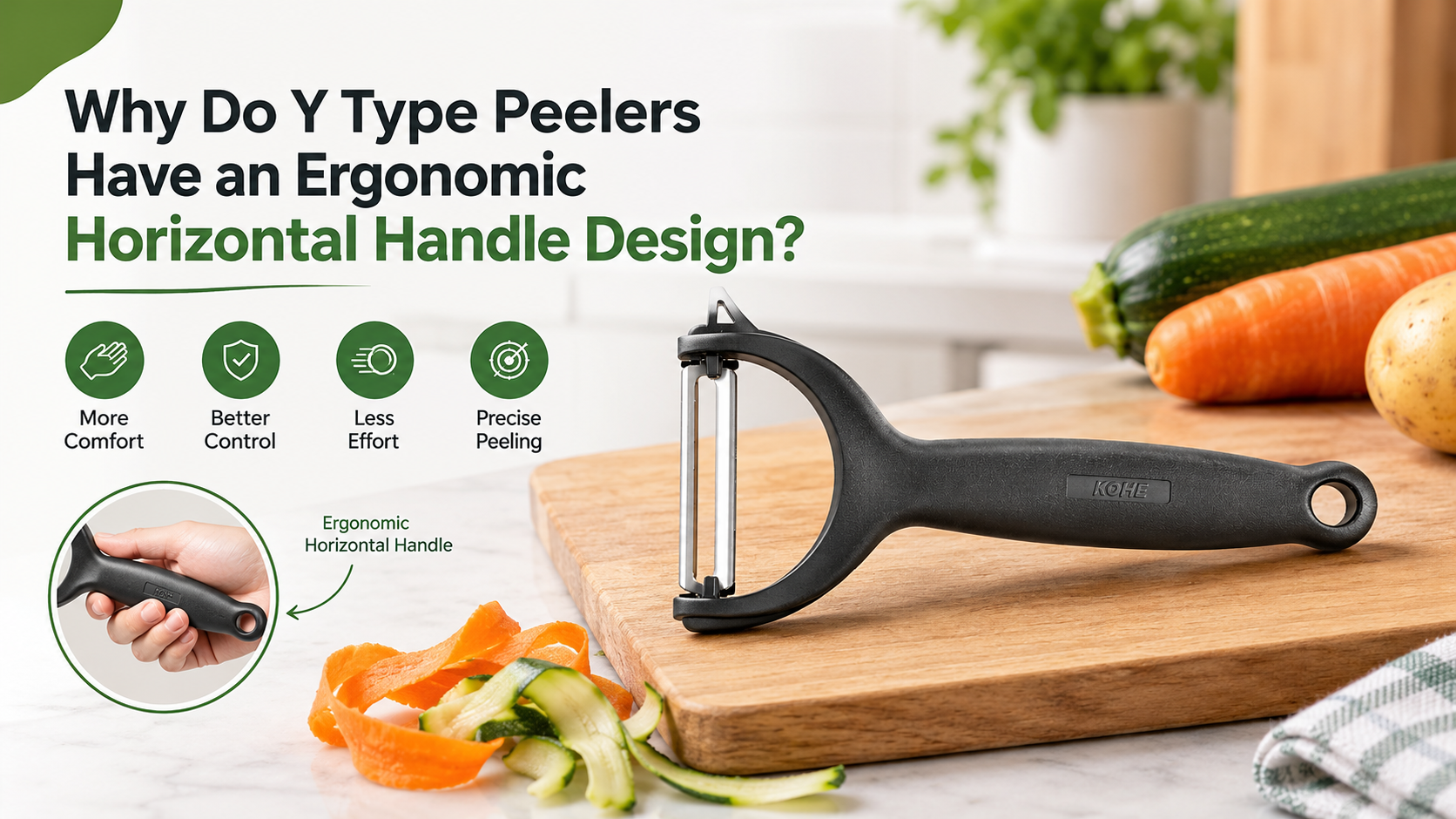
A vegetable peeler is a simple kitchen tool, but its design can make a noticeable difference in comfort, control, and efficiency during food preparation. Among the different types available, Y type peelers are recognized by their horizontal blade and handle arrangement. Unlike traditional straight peelers, which generally have a blade aligned with the handle, a Y type peeler has a crosswise blade positioned at the head of the tool. This design influences how users hold, move, and control the peeler while removing the skin from vegetables and certain fruits.
The ergonomic horizontal handle design of Y Type Peelers aims to provide a comfortable grip and support controlled peeling movements. The handle allows users to guide the blade across the surface of an ingredient while maintaining a natural hand position. However, comfort depends on several factors, including handle shape, grip material, hand size, blade sharpness, and the amount of pressure applied.
For home cooks, food preparation professionals, and kitchen tool buyers in Ludhiana, understanding these design features can help when comparing different vegetable peelers. A suitable peeler should be easy to control, comfortable to hold, and appropriate for the ingredients being prepared.
This article explains why Y type peelers use a horizontal handle design, how ergonomics affects everyday use, and what to consider when selecting a peeler for regular kitchen tasks. It also discusses practical maintenance and safety considerations that influence long-term usability.
What Is a Y Type Peeler?
A Y type peeler is a manual kitchen utensil designed to remove thin outer layers from vegetables and some fruits. It is named after its general shape, which resembles the letter Y when viewed from certain angles.
Its main components usually include:
- Horizontal blade: The cutting edge extends across the head of the peeler.
- Handle: The user holds this section to guide the blade over the ingredient.
- Blade support: The frame holds the blade in position during peeling.
- Swivel blade mechanism: Many models allow the blade to pivot slightly, helping it follow curved surfaces.
The exact construction varies between models. Some feature stainless steel blades, while handle materials may include plastic, rubberized materials, or metal.
The defining feature is the relationship between the blade and handle. This arrangement changes the direction of hand movement compared with many straight peelers.
Why Do Y Type Peelers Have an Ergonomic Horizontal Handle Design?
The horizontal handle and blade arrangement is intended to support comfortable handling and controlled peeling. Rather than relying only on the fingers to guide a narrow blade, users can hold the handle and move the peeler across the ingredient using a coordinated hand and wrist movement.
Several design considerations explain this arrangement.
1. It Supports a Stable Grip
A well-shaped handle provides a surface that the fingers and palm can hold securely. This can make it easier to guide the blade while peeling firm vegetables such as potatoes, carrots, and cucumbers.
Handle thickness, surface texture, and overall shape affect grip quality. A handle that is too narrow may require excessive finger pressure, while one that is too thick may be difficult for users with smaller hands to hold comfortably.
Ergonomic performance therefore depends on the complete handle design, not simply its horizontal orientation.
2. It Helps Users Control the Peeling Movement
The horizontal blade allows users to move the peeler across a vegetable’s surface in a controlled direction. This arrangement can feel intuitive when removing long strips of skin from ingredients such as carrots or cucumbers.
A controlled movement helps users adjust the angle and pressure applied to the blade. The aim is to remove the outer skin without unnecessarily cutting deeply into the edible portion.
The result depends on blade sharpness, the ingredient’s shape, and the user’s technique. A horizontal design alone does not guarantee uniform peeling.
3. It Can Reduce Unnecessary Wrist Adjustments
During repetitive food preparation, users frequently change their hand position to follow the shape of an ingredient. The handle and blade alignment of a Y type peeler may allow a relatively direct peeling movement for certain tasks.
Depending on the user’s grip and working position, this can reduce the need for awkward hand adjustments. However, it does not eliminate wrist movement or guarantee reduced strain.
For extended kitchen work, maintaining a neutral wrist position, using an appropriate working height, and taking breaks remain important. People who experience discomfort should reconsider their technique and tool choice rather than assuming that an ergonomic handle will solve every problem.
4. It Supports a Consistent Blade Angle
The horizontal blade provides a broad cutting edge across the peeler’s head. When used correctly, this can help users maintain a reasonably consistent angle while removing strips of vegetable skin.
A consistent angle is useful when preparing ingredients for salads, cooking, or other dishes where the amount of removed skin matters.
The blade should remain close to the surface rather than being forced deeply into the ingredient. Sharpness and appropriate pressure are essential for controlled results.
5. It Can Be Convenient for Repetitive Preparation
Preparing several kilograms of vegetables in a home or commercial kitchen involves repeated hand movements. A comfortable handle can make this work easier to manage, especially when the tool fits the user’s hand properly.
For professional kitchens in Ludhiana, including restaurants and catering operations, handle comfort is one consideration when choosing manual preparation tools. Blade performance, cleaning requirements, durability, and safe storage also matter.
How Does the Horizontal Handle Compare With a Straight Peeler?
The two designs perform similar tasks, but their geometry influences how users hold and move them.
| Feature | Y Type Peeler | Straight Peeler |
| Blade arrangement | Usually perpendicular to the handle | Generally aligned with the handle |
| Grip position | Often resembles holding a small handle across the palm | Often resembles holding a narrow cutting tool |
| Typical movement | Crosswise or sweeping strokes | Forward, backward, or lengthwise strokes |
| Handling curved surfaces | Can follow curves when the blade and technique are suitable | Can also follow curves, depending on blade design |
| Comfort | Depends on grip, hand size, and technique | Depends on grip, hand size, and technique |
Neither design is universally more comfortable. Some users prefer the wider grip and sweeping movement of Y type peelers, while others find a straight peeler easier to manoeuvre for particular ingredients or smaller tasks.
The practical choice depends on the vegetables being prepared, the user’s preferred movement, and the tool’s construction.
Which Features Make a Y Type Peeler More Ergonomic?
When evaluating Y type peelers, consider the following features rather than focusing only on appearance.
Handle Shape and Thickness
The handle should fit comfortably in the hand without forcing the fingers into an awkward position. Rounded edges and a suitable thickness may improve comfort during repeated use.
Grip Texture
A textured or non-slip handle can help maintain control, particularly when hands become damp during food preparation. The surface should remain easy to clean.
Blade Sharpness
A properly maintained blade generally requires less force than a dull one. Excessive force can reduce control and increase the risk of slipping.
Blade Movement
Some Y type peelers use a swivel blade that adjusts to the contours of an ingredient. This may help when peeling curved vegetables, although the quality and range of movement differ by model.
Overall Balance
The weight distribution between the handle and blade can affect how easily users guide the tool. A balanced peeler should feel manageable rather than excessively heavy or difficult to direct.
How to Use Y Type Peelers Comfortably and Safely
Ergonomic design works most effectively when combined with appropriate handling.
Follow these practical steps:
- Wash the ingredient: Remove soil and surface debris before peeling.
- Hold the handle securely: Keep your fingers around the grip without squeezing it excessively.
- Stabilise the ingredient: Place it on a stable cutting board or hold it securely, keeping fingers away from the blade’s path.
- Use controlled strokes: Move the blade with steady pressure rather than forcing it into the vegetable.
- Adjust your position: Rotate the ingredient when necessary instead of twisting your wrist excessively.
- Clean the tool after use: Remove food residue and dry the peeler according to its material and care instructions.
Avoid peeling towards your fingers or using a damaged, loose, or visibly blunt blade. If the tool repeatedly slips, stop and correct the grip or replace the peeler if necessary.
Choosing Y Type Peelers for Kitchens in Ludhiana
Kitchen tool requirements vary between households, restaurants, caterers, and other food preparation settings in Ludhiana. A person preparing vegetables occasionally may prioritise ease of handling and storage, while a commercial kitchen may place greater emphasis on repeated-use comfort and straightforward cleaning.
Before selecting a model, consider:
- Whether the handle fits your hand comfortably.
- Whether the grip remains secure when damp.
- Whether the blade removes thin, controlled layers.
- Whether the blade mechanism moves smoothly, if applicable.
- Whether the materials and construction suit regular use.
- Whether the tool is easy to clean and store safely.
When researching Y type peelers, product information associated with Kohe KGOC can be considered alongside these practical criteria. Compare the available specifications and actual design features rather than assuming that every model offers identical ergonomic benefits.
How Should You Maintain a Y Type Peeler?
Regular maintenance helps preserve the tool’s usability and hygiene.
After each use, wash the peeler according to the manufacturer’s instructions. Pay particular attention to food residue around the blade, frame, and any moving parts. Dry it thoroughly when required to reduce moisture-related deterioration.
Store the peeler in a drawer organizer or another location where the blade cannot accidentally contact fingers. If the blade becomes loose, damaged, or difficult to control, discontinue use until the issue is resolved.
Do not assume that every peeler is dishwasher-safe. Check the product’s care instructions before using a dishwasher or applying strong cleaning agents.
Conclusion
The ergonomic horizontal handle design of Y type peelers provides a practical alternative to the traditional straight peeler arrangement. Its crosswise blade can support controlled sweeping movements, while a well-shaped handle may improve grip and comfort during routine vegetable preparation.
However, ergonomic performance depends on more than the overall shape. Handle fit, grip texture, blade sharpness, balance, maintenance, and proper technique all influence how comfortably and safely a peeler works.
For households and food preparation professionals in Ludhiana, understanding these factors can make product comparisons more useful. When exploring Y type peelers, including options associated with Kohe KGOC, review the actual construction and specifications and consider how the tool fits your everyday kitchen tasks.
FAQs
1. Why do Y type peelers have a horizontal handle design?
Y type peelers use a crosswise blade and handle arrangement to support a controlled peeling movement. The design can feel comfortable for sweeping strokes across vegetables, although the actual ergonomic benefit depends on handle shape, grip, blade quality, and individual preference.
2. Are Y type peelers more comfortable than straight peelers?
Not for every user. Some people prefer the grip and movement of a Y type peeler, while others find straight peelers easier to control. Trying both designs, where possible, can help identify which feels more natural for the intended task.
3. Can Y type peelers help reduce hand fatigue?
A comfortable grip and sharp blade may reduce the effort required for repetitive peeling. However, fatigue also depends on task duration, hand position, applied pressure, and working technique. No particular peeler design can guarantee that fatigue will be prevented.
4. What should buyers in Ludhiana check before selecting Y type peelers?
Check the handle fit, grip texture, blade sharpness, construction, ease of cleaning, and suitability for the intended ingredients. Buyers comparing products associated with Kohe KGOC should review the specifications of the particular model rather than relying on the product category alone.
5. How can a Y type peeler be kept in good condition?
Clean it after use, remove food residue, dry it as directed, and store it safely. Inspect the blade and frame regularly. Replace or stop using the tool if it becomes damaged, loose, or unsafe to handle.