





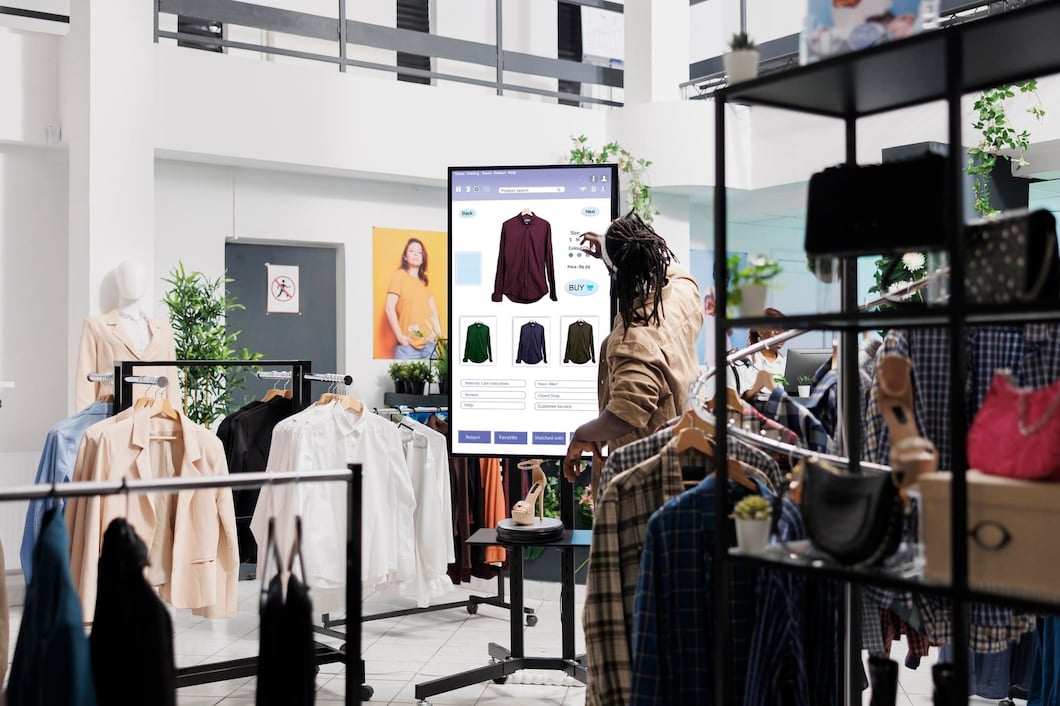
For most retail businesses, the choice between a digital price tag and a traditional paper label comes down to three things: cost, effort, and long-term value. Digital price tags use wireless technology to update pricing instantly across an entire store, while paper labels require manual printing and replacement. For high-volume retailers managing hundreds of SKUs, digital systems reduce labour costs significantly and eliminate pricing errors at the shelf.
What Is a Digital Price Tag and How Does It Work?
A digital price tag — also called an electronic shelf label (ESL) — is a small display unit mounted on a shelf edge. It connects wirelessly to a central pricing system, allowing store managers to push price changes across every shelf simultaneously from a single dashboard.
Most ESL systems use e-ink displays, which are energy-efficient and highly readable even under bright supermarket lighting. Updates can be triggered manually or automated to sync with your ERP or point-of-sale software.
Paper Price Labels: Still Viable or Already Outdated?
Paper price labels have been the retail standard for decades. They are inexpensive upfront and require no technical infrastructure. For a small boutique with a slow-moving product range, paper labels may still make practical sense.
However, the hidden costs accumulate quickly. Every price change means printing, cutting, and physically replacing labels across every affected shelf — a time-consuming process that is also prone to human error. In a supermarket environment with thousands of SKUs and frequent promotions, this becomes a genuine operational burden.
Digital Price Tags vs Paper Price Tags: A Direct Comparison
| Factor | Digital Price Tag | Paper Price Label
|
|---|---|---|
| Setup Cost | Higher upfront investment | Low initial cost |
| Price Update Speed | Seconds, store-wide | Minutes to hours per update |
| Labour Required | Minimal — managed centrally | High — manual shelf visits required |
| Accuracy | Consistent, system-synced | Prone to human error |
| Maintenance | Battery replacement every few years | Ongoing paper, ink, and printing costs |
| Sustainability | Reduces paper waste significantly | Continuous paper and plastic waste |
| Promotions Handling | Instant, scheduled, or automated | Manual, time-sensitive, error-prone |
| Long-Term Value | Strong ROI over 3–5 years | Lower ROI at scale |
Setup and Installation: What Retailers Need to Know
Installing a digital pricing system requires a one-time infrastructure investment. This typically includes the ESL display units, a wireless gateway network, and integration with your existing inventory or POS system. For a mid-sized supermarket, this can be a significant upfront cost — but it is a capital expense, not a recurring one.
Paper labels, by contrast, have virtually no setup cost. You need a printer, label stock, and staff time. The problem is that “staff time” is where costs silently compound over months and years.
How Long Does ESL Setup Take?
A typical ESL deployment for a mid-sized retail store in Singapore can be completed within a few days, depending on store size and the complexity of the system integration. Most suppliers provide installation support and staff training as part of the rollout package.
Labour and Pricing Updates: Where the Real Difference Shows
This is where digital price tags deliver the most measurable advantage. In a conventional supermarket running weekly promotions, staff may spend several hours per week changing paper labels manually. Across a team, that translates into significant labour costs per year.
With an ESL system, a price change across 500 products takes under a minute. Promotional pricing can be pre-scheduled so labels update automatically at midnight before a sale begins — with no staff involvement required at that hour.
For supermarket operators in Singapore managing GST adjustments, regular supplier price changes, or time-limited promotions, this operational efficiency is a direct competitive advantage.
Pricing Accuracy and Compliance
Under Singapore’s Consumer Protection (Fair Trading) Act, retailers are responsible for ensuring that shelf prices match the prices charged at checkout. Discrepancies — even unintentional ones caused by delayed label updates — can lead to customer complaints and regulatory scrutiny. Digital price labels eliminate this risk by keeping shelf and system prices in sync at all times.
Long-Term Value: Which Option Saves More Money?
Paper labels appear cheaper because the cost is spread out and easy to overlook. But when you account for printing supplies, staff hours, error corrections, and reprint cycles, the cumulative cost is substantial.
Research from the retail technology sector suggests that ESL systems typically achieve return on investment within two to three years for medium to large-format stores. For high-frequency retailers — those updating prices multiple times per week — the payback period can be even shorter.
Digital price tags also reduce shrinkage risk. When shelf prices are always accurate, there is less opportunity for pricing disputes that sometimes lead to goods being given away at the wrong price.
Which Type of Retailer Benefits Most from Digital Price Tags?
Not every retailer needs to make the switch immediately. Here is a practical breakdown:
- Supermarkets and hypermarkets: Strongest ROI due to high SKU count and frequent price changes.
- Pharmacies and health stores: Benefit from accuracy and easy compliance with promotional pricing rules.
- Electronics and appliance retailers: High-value products where pricing errors are costly.
- Convenience stores: Growing case for ESLs as labour costs rise and product ranges expand.
- Small boutiques with static pricing: Paper labels may still be sufficient in the near term.
Sustainability: A Growing Priority for Singapore Retailers
Singapore’s Green Plan 2030 encourages businesses to reduce waste across operations. Paper label systems generate consistent waste — label stock, backing sheets, and outdated labels discarded with every price change cycle. ESL systems, once installed, produce virtually no ongoing material waste.
For retailers looking to align with sustainability reporting requirements or attract environmentally conscious consumers, switching to a digital pricing system sends a clear operational signal.
Making the Right Choice for Your Store
If your store runs frequent promotions, manages a large product range, or is experiencing rising labour costs, the move to a digital price tag system is worth serious evaluation. The upfront investment is real — but so is the long-term payoff in time saved, errors avoided, and staff redeployed to higher-value tasks.
For retailers in Singapore ready to explore ESL options, Hubs offers a range of electronic shelf label solutions designed for supermarkets, pharmacies, and retail chains. Their product range covers varying display sizes and connectivity options to suit different store formats and operational needs.
Read more: IP Ratings Explained: Choosing Weatherproof Outdoor Digital Signs
Frequently Asked Questions
What is a digital price tag used for in retail?
A digital price tag is an electronic display mounted on a shelf edge that shows product pricing. It connects wirelessly to a central system, allowing retailers to update prices instantly across an entire store without manually replacing paper labels.
Are electronic shelf labels worth the investment for small retailers?
For small retailers with a limited product range and infrequent price changes, the ROI on electronic shelf labels may take longer to realise. However, as store size and promotional frequency increase, ESLs typically pay for themselves within two to three years.
How often do digital price tag batteries need replacing?
Most e-ink digital price tags are highly energy-efficient. Battery life typically ranges from three to seven years depending on the model and how frequently the display is updated, making ongoing maintenance costs minimal for most retail environments.
Can digital price labels integrate with existing POS systems?
Yes. Most modern digital price label systems are designed to integrate with common POS and ERP platforms. Once connected, price changes made in your central system are automatically reflected on the shelf display, reducing manual input and pricing discrepancies.
Do Singapore retailers have any legal obligation regarding shelf pricing accuracy?
Yes. Under the Consumer Protection (Fair Trading) Act in Singapore, retailers must ensure shelf prices match checkout prices. Digital pricing systems help maintain this compliance automatically by syncing shelf labels with the point-of-sale system in real time.
What is the difference between a digital price tag and an electronic shelf label?
They refer to the same technology. “Electronic shelf label” (ESL) is the industry term used by suppliers and integrators, while “digital price tag” is the more commonly searched consumer-facing term. Both describe wireless, updateable shelf-edge displays used in modern retail stores.