








Key Takeaways
- Your regulator sets the rules. DHA in Dubai, DoH in Abu Dhabi and MoHAP federally (including the Northern Emirates) each shape what your app must meet. One generic checklist will not do.
- Decide where data lives on day one. Federal Law No. 2 of 2019 restricts moving health data outside the UAE, so early architecture choices save expensive rework later.
- Plan exchange integration at discovery. Connecting to Nabidh, Malaffi or Riayati improves clinical efficiency and cuts duplicate data entry.
- Build trust into the experience. Clear consent, secure sign-in and Arabic and English interfaces enhance user experience and drive patient adoption.
- Treat AI features as regulated features. The national AI policy launched on 25 November 2026 puts governance, ethics, data protection and patient rights in focus.
- Pick a partner for healthcare depth, not price alone. The right team helps you stay competitive in a rapidly evolving market without compliance surprises.
A healthcare app can pass every functional test and still fail before launch. The booking flow works, the video consultation connects and the patient dashboard looks polished, yet a regulator, a hospital security team or a health information exchange pushes it back because of how patient data is stored, shared or accessed.
That risk is growing as digital care becomes routine across Dubai, Abu Dhabi and the other Emirates. Patients expect to book, consult and view results from their phones. Providers expect those tools to connect with electronic medical records and national exchanges. Regulators are raising the bar in step: Dubai Health Authority (DHA) Standards for Telehealth Services, Version 4 took effect on 26 November 2025, and the Ministry of Health and Prevention (MoHAP) launched its national smart health and AI policy on 25 November 2026.
For any business investing in healthcare app development UAE, the lesson is simple: compliance is part of the product, not a legal review at the end. This guide explains the regulatory landscape, the challenges behind most delays and rework, the exchanges your app may need to connect to, and how to judge a development partner before you sign.
Understanding the UAE Healthcare Regulatory Landscape Before App Development
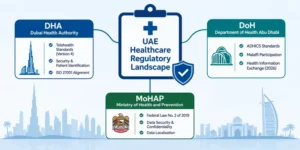
The UAE has no single healthcare app rulebook. Requirements depend on the emirate where patients are treated, the type of service your app supports and which authority licenses the provider behind it. A telemedicine app for a Dubai clinic faces different checks from a patient portal for an Abu Dhabi hospital group. Identifying the right regulator first is the most valuable decision in discovery.
Dubai Health Authority (DHA): Telehealth and Platform Requirements
DHA licenses providers in Dubai and publishes the Standards for Telehealth Services. Version 4 was issued on 26 September 2025 and took effect on 26 November 2025. It runs from facility licensure through to security, records and mandatory reporting of key performance indicators. For an app, that means patient identification, authentication, secure communication and clinical record handling must be designed in from the start, and agreements between the provider and its technology partners should be clear. Providers also tend to ask partners for evidence aligned to recognised frameworks such as ISO 27001, so confirm what the current standard requires for your service model rather than relying on a generic checklist.
DoH Abu Dhabi: ADHICS and Health Information Exchange
The Department of Health (DoH) regulates Abu Dhabi. Its Abu Dhabi Healthcare Information and Cyber Security Standard (ADHICS) sets expectations for data classification, access control and cybersecurity for healthcare entities and the third parties handling their information. DoH also requires licensed facilities to take part in Malaffi, and its Health Information Exchange Standards 2026 mandate specific coding standards, units of measurement and a minimum data set for information sent from source EMRs.
MoHAP: Federal Healthcare Regulations
Federal Law No. 2 of 2019 on the use of ICT in health fields applies across the UAE, including free zones. It covers confidentiality, authorised access, data security and data localisation under Article 13, supported by Cabinet Resolution No. 32 of 2020. MoHAP is also the direct regulator for the facilities it licenses, mainly in the Northern Emirates.
Quick Question: “Does compliance with one regulator cover the whole UAE?”— No. Federal law applies everywhere, but emirate regulators add their own standards. An app serving clinics in Dubai and Abu Dhabi must satisfy both, alongside the federal rules.
| Regulator | Where it applies | What matters most for your app | Key references |
|---|---|---|---|
| DHA | Dubai | Telehealth standards, patient identification, platform security, Nabidh | Standards for Telehealth Services v4; NABIDH policies |
| DoH | Abu Dhabi | ADHICS, Malaffi participation, HIE data standards | ADHICS; HIE Standards 2026 |
| MoHAP | Federal; facilities it licenses | Confidentiality, data localisation, Riayati | Federal Law No. 2 of 2019; Cabinet Resolution No. 32 of 2020 |
The Healthcare App Compliance Challenges Businesses Cannot Afford to Ignore
Most delayed healthcare launches trace back to the same four problems. Each one is cheaper to solve at the design stage than after the first security review.
Protecting Sensitive Patient Information and Medical Records
Medical records are among the most sensitive data an app can handle. Federal law requires confidentiality and authorised access, and healthcare regulators expect layered controls: encryption in transit and at rest, role-based access, and audit logs that show who viewed or changed each record. A common failure is a staff app where every logged-in user can search every patient. The data may be encrypted, but the access model still fails review. Build permissions around job roles, and log every access to a clinical record.
UAE Data Residency and Cross-Border Data Transfers
Article 13 of Federal Law No. 2 of 2019 bars health data from being stored, processed, generated or transferred outside the UAE unless an exception applies. Ministerial Decision No. 51 of 2021 created ten exceptions, covering cases such as overseas patients, samples sent to foreign laboratories, research and telemedicine operations. Many require patient approval, and where transfer is allowed, a copy of the data must still be kept inside the UAE.
In practice, residency is rarely about the main database alone. Overseas SMS gateways, analytics tools, crash-reporting SDKs, AI APIs and offshore support access can all move health data across the border. Map every data flow before you choose hosting, and take legal advice on which exception, if any, your model relies on.
Patient Consent, Identity Verification and Authentication
Consent has to be captured clearly, recorded and honoured every time data is used or shared. Dubai’s NABIDH consent and access control policy, for example, expects facilities to verify consent status at the time of use and disclosure. Pair that with reliable patient identification, multi-factor authentication for staff and sensitive actions, sensible session timeouts, and a retrievable history of consent and access.
Healthcare App Certification, Licensing and Audit Readiness
Depending on the service, the provider behind your app may need licensing or approval before it goes live, and it stays accountable to the regulator for what its technology partners do. Expect security questionnaires, technical assessments and audits. Keep architecture diagrams, penetration test reports, access-control matrices and incident response plans current. Raise these needs at discovery, because retrofitting documentation after development is slow and expensive.
A Practical Compliance Checklist
- Confirm the licensing authority and the applicable standards in writing.
- Map every data flow and storage location, including vendors, backups and analytics.
- Define roles and permissions, and log all access to patient records.
- Encrypt data in transit and at rest, with documented key management.
- Record patient consent and enforce it at the point of use.
- Apply multi-factor authentication and session controls.
- Schedule penetration testing and keep an incident response plan.
- Confirm exchange integration requirements (Nabidh, Malaffi or Riayati).
- Document vendor responsibilities for security, support and maintenance.
Integrating Healthcare Apps with Malaffi, Nabidh and Riayati
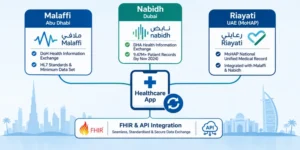
Interoperability is where many UAE healthcare projects stall. An app that cannot read from or write to the right exchange leaves clinicians re-keying data, which cancels the efficiency gains it was built to deliver. As a rule, the exchange depends on who licenses the facility: DoH-licensed facilities connect to Malaffi, DHA-licensed facilities to Nabidh, and MoHAP-licensed facilities to Riayati. Confirm the exact obligation with each facility and its regulator.
Malaffi Integration for Abu Dhabi Healthcare Applications
Malaffi is Abu Dhabi’s health information exchange, operated by Abu Dhabi Health Data Services in partnership with DoH. DoH requires licensed facilities to participate, and its standards set out the HL7 message types, coding standards and minimum data set that source EMRs must send. Plan for code mapping, message testing, handling of rejected messages and the onboarding process with the Malaffi team, because each adds time to the schedule.
Nabidh Integration for Dubai Healthcare Providers
Nabidh is DHA’s platform for the secure exchange of unified health information. By November 2024 it had unified more than 9.47 million patient records across 1,300+ facilities. Its published policies cover authentication and authorisation, consent and access control, auditing and breach notification, so an app connected to it inherits those expectations. Connection requirements differ by provider and EMR, so confirm them with the facility and DHA before you fix scope.
Riayati and the Move Towards Connected National Healthcare Records
Riayati is MoHAP’s National Unified Medical Record. Since January 2023 it has been integrated with Malaffi and Nabidh, and later phases aim to let users reach Malaffi and Nabidh data through Riayati across emirates. The practical takeaway: build on standardised data models so an app launched in one emirate can extend to others without a rebuild.
Why FHIR and API-Based Integration Matter
Many exchange feeds still rely on HL7 messaging, while FHIR and secure APIs make it easier to connect EMR, EHR, laboratory and pharmacy systems with less bespoke plumbing. Because every provider’s systems differ, integration usually calls for custom software development services rather than an off-the-shelf connector. Whatever the standard, plan data validation, error handling and monitoring. A lab result that arrives with the wrong unit or code is a clinical risk, not a cosmetic bug.
What the UAE’s New National Healthcare AI Policy Means for App Development
On 25 November 2026, MoHAP launched the National Policy for the Promotion of Smart Health Services and Artificial Intelligence in the Health Sector. Per the Emirates News Agency, it covers governance and partnerships, digital infrastructure and skills, the security of smart health services, ethical use, innovation, research, data protection and patients’ rights. The published policy text also points to quality assurance for AI solutions, including generative AI, and to clear medical liability frameworks. A policy sets direction rather than technical rules, so build AI features that can adapt as regulators publish detail.
Responsible AI and Patient Data Protection
Expect governance, accountability and transparency to matter. In practice, that means recording which model version produced each output, explaining AI-assisted suggestions to clinicians in plain terms, honouring patient privacy and consent, and keeping a qualified human in the clinical loop.
AI-Powered Features Healthcare Apps Can Support
The most defensible use cases are those that support clinicians and staff rather than replace their judgement: patient engagement and triage assistants, predictive health analytics, clinical decision support, appointment and administrative automation, and insights from remote patient monitoring. Teams planning these features should invest in clean data pipelines and consent controls first, because custom AI app development is only as reliable as the data and governance underneath it.
Quick Question: “Does the policy ban AI features in healthcare apps?”— No. Its stated aim is to expand preventive care and improve quality through smart, responsible adoption of technology. The safeguards are the point, not a prohibition.
Avoiding Risks When Implementing AI in Healthcare
The main risks are biased or inaccurate outputs, unvalidated clinical claims, poor data quality and model drift over time. Validate clinically before release, monitor performance after launch, and route high-impact decisions to human review. Check data residency too: sending patient data to an AI service hosted abroad can collide with Article 13.
Essential Security and Technology Requirements for a UAE Healthcare App
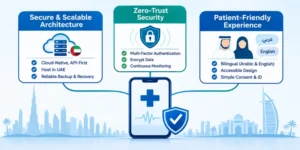
Choosing a Secure and Scalable Healthcare App Architecture
A cloud-native, API-first architecture lets an app scale with patient demand and plug into EMRs and exchanges without constant rework. Host in the UAE wherever residency rules require it, keep development, test and production environments separate, and choose databases that scale. Test backup and recovery inside the country, not just on paper.
Implementing Zero-Trust Security and Access Management
Zero-trust means no request is trusted because of where it comes from. Verify every user and device, apply role-based access, require multi-factor authentication, encrypt data at rest and in transit, and monitor continuously. Keep tamper-evident audit trails so you can answer a regulator’s question about who accessed a record, and when.
Building a Patient-Friendly Arabic and English Experience
Compliance does not help if patients cannot use the app. Support Arabic and English with true right-to-left layouts, accessible design, plain-language consent screens and simple identity verification. Where the provider’s workflow supports it, consider how the app will work with UAE-specific digital identity and government services. Because most patients will use a phone, work with a custom mobile app development company that tests on real devices and treats security and usability as one job, not two.
How to Choose the Right Healthcare App Development Company in UAE
Quotes from different vendors can look alike. The real differences are in risk: who understands the regulators, who has connected systems to health exchanges before, and who will still be accountable after launch.
Check Healthcare Industry and Regulatory Experience
A capable healthcare app development company should explain, without prompting, how DHA, DoH and federal requirements affect your design. Ask for concrete scenarios rather than slogans: how they handled consent, data residency or an exchange onboarding, and what they would do differently.
Evaluate Technical and Integration Capabilities
Look for hands-on EMR and EHR integration, working knowledge of HL7 and FHIR, secure cloud and cybersecurity practice, and structured testing for interoperability.
Look Beyond Development Cost
The cheapest quote often leaves out security testing, documentation or exchange onboarding. Compare what each proposal includes for compliance planning, testing, maintenance, support and future scalability.
Red Flags to Watch Before Signing a Development Contract
- A promise of guaranteed compliance before they understand your project.
- No discussion of security or data architecture.
- No clear integration strategy for your EMR or exchange.
- Vague ownership of code, data and ongoing maintenance.
How SISGAIN Helps Build Healthcare Applications for UAE Businesses
Healthcare-Focused Application Development
SISGAIN is an IT software development company founded in 2009, with healthcare software development among its service areas. For healthcare providers, hospitals, clinics and digital health startups in the UAE, that means a development partner that works with healthcare workflows rather than treating them as a generic app project.
Building Around Integration, Security and Business Requirements
Based on its published service information, SISGAIN’s healthcare capabilities include:
- Healthcare application development
- Custom healthcare software solutions
- Telemedicine application development
- Healthcare system integration
- Scalable application architecture
These map directly to the challenges covered in this guide: connecting apps to existing systems, designing for security and growth, and shaping the build around your service model.
Discuss Your Healthcare App Requirements with SISGAIN
Planning a healthcare app for the UAE market? Share your target emirate, service model, integration needs and development roadmap, and discuss how a tailored build could address them. Book a consultation with SISGAIN to turn your requirements into a clear plan.

Conclusion
Compliance is the foundation of a healthcare app, not the last step before launch. Regulatory requirements, patient data security and interoperability have to be planned together, because a decision in one area changes the others. Start with the regulator for your target emirate, design around data residency, confirm your exchange integration needs, and choose a partner who can show how they handle all three. Done early, this approach reduces rework, builds patient trust and helps your app stay competitive as UAE digital health keeps moving. Ready to turn your requirements into a compliant, integration-ready roadmap? Book a consultation and start with the right questions.
Frequently Asked Questions
What regulations apply to healthcare app development in UAE?
Federal Law No. 2 of 2019 and its executive rules apply nationwide. On top of that, DHA standards (including the Telehealth Standards) apply in Dubai, DoH standards (including ADHICS and the HIE standards) in Abu Dhabi, and MoHAP rules for facilities it licenses. Take legal advice for your specific model.
Does a healthcare app need DHA approval in Dubai?
It depends on the service. If the app supports telehealth or clinical services for a DHA-licensed provider, DHA’s telehealth standards and licensing requirements are likely to apply. Confirm with DHA and your provider early.
Is HIPAA certification mandatory for healthcare apps in UAE?
HIPAA is a US law, and UAE apps are assessed against UAE federal and emirate requirements. Providers may still request security evidence aligned to international frameworks, so check the relevant standard and your contract.
Do healthcare apps need Malaffi or Nabidh integration?
Often, through the facility’s EMR. DoH requires licensed Abu Dhabi facilities to take part in Malaffi, and DHA-licensed facilities in Dubai connect to Nabidh. Your app’s role decides the exact obligation.
Is UAE-based cloud hosting required for healthcare applications?
Article 13 restricts storing or processing health data outside the UAE unless an exception applies, so UAE hosting is the safest default. Exceptions carry conditions, including keeping a copy in the UAE.
How much does healthcare app development cost in UAE?
Cost depends on scope: user roles, integrations, telemedicine, AI features, security testing and ongoing support. A reliable figure needs a scoped brief rather than a generic range.
How long does it take to develop a healthcare application in UAE?
Timelines depend on scope. The biggest variables are exchange onboarding, security testing and provider or regulator approvals, which sit outside the development team’s control. Build them into the plan from day one.